Ukraine Strikes Russian Industry
Ukrainian drones damaged industrial areas deep inside Russia overnight, while a Russian strike set homes ablaze in Kharkiv and injured civilians.

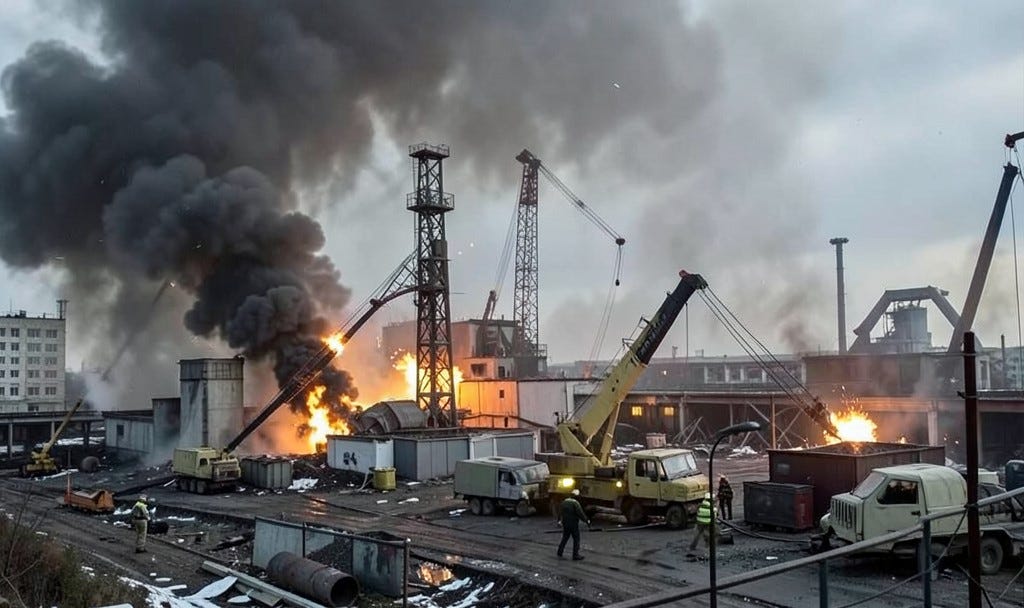
Ukrainian drones struck industrial areas in western Russia overnight into Wednesday, with damage reported in Novomoskovsk south of Moscow and explosions near Lipetsk, one of the country’s largest steel-producing centers.
Russia’s Defence Ministry claimed its air defenses intercepted 531 Ukrainian drones between 8 p.m. Tuesday and 8 a.m. Wednesday, Moscow time. The figure has not been independently verified.
At the same time, Russia launched another overnight attack on Ukraine. A jet-powered drone hit residential buildings in Kharkiv, starting a major fire and affecting five civilians, including a four-year-old boy.
Industrial Site Damaged South of Moscow
Dmitry Milyayev, governor of Russia’s Tula region, confirmed that a large drone attack damaged industrial infrastructure in Novomoskovsk, about 200 kilometers south of Moscow.
Homes and apartment buildings were also damaged.
Emergency crews, environmental laboratories and health inspectors were sent to the city, an important center for Russia’s chemical industry.
Ukrainian monitoring groups Exilenova+ and Supernova+ reported that the Azot chemical plant had been targeted and published footage showing a large fire.
The EuroChem-owned plant produces ammonia, ammonium nitrate, urea and methanol. Ukrainian intelligence has previously linked its output to companies involved in Russia’s explosives industry.
Russian regional authorities confirmed damage in the industrial zone but did not identify the facility. The location and scale of the reported plant fire remain unverified.
Explosions Reported Near Lipetsk Steelworks
Explosions and flames were also reported in Lipetsk, home to the Novolipetsk Metallurgical Plant, one of Russia’s largest steelworks.
Regional Governor Igor Artamonov said 45 drones had been intercepted. One person sought medical treatment, while falling debris damaged residential property.
Artamonov rejected reports that the steel plant itself was burning, saying debris had instead ignited vegetation.
Russia’s Defence Ministry said drones had been intercepted over 12 regions, including Tula, Lipetsk, Bryansk, Voronezh, Rostov and Kursk, as well as the Moscow region.
The ministry’s total of 531 represents Russia’s own account of intercepted drones and does not establish how many aircraft Ukraine launched or how many reached their targets.
Russian Drone Sets Kharkiv Homes Ablaze
In northeastern Ukraine, a Russian jet-powered drone struck Kharkiv’s Osnovianskyi district late Tuesday.
The attack started fires covering around 2,500 square meters and damaged apartment buildings, private homes, outbuildings and an industrial facility.
Ukraine’s State Emergency Service said five people were affected, including a four-year-old boy. Regional authorities said three adults required hospital treatment.
Firefighters worked through the night to contain the blaze.
Ukraine’s Air Force said Russia launched 88 drones and one ballistic missile overnight, including 38 jet-powered drones.
Ukrainian forces claimed 71 drones were intercepted or electronically suppressed, including 31 jet-powered aircraft. Impacts were recorded at eight locations.
The faster jet-powered drones reduce the time available for Ukrainian air-defense teams to detect and engage incoming weapons.
Ukraine Pushes Deeper Into Russian Industry
The overnight attacks show Ukraine continuing to push its long-range drone campaign against industrial infrastructure supporting Russia’s war effort.
Chemical production, steelmaking and military-linked supply chains have become increasingly important targets as Kyiv seeks to raise the economic and logistical cost of Russia’s invasion.
Russia, meanwhile, continues using missiles and increasingly advanced drones against Ukrainian cities, placing civilians and civilian infrastructure under repeated attack far from the front line.
Discussion about this post