Ukraine Seeks Guarantees Beyond a Ceasefire
Ukraine’s urgent need for air defence and communications shaped the talks. Nordic partners are developing systems Kyiv could control itself.

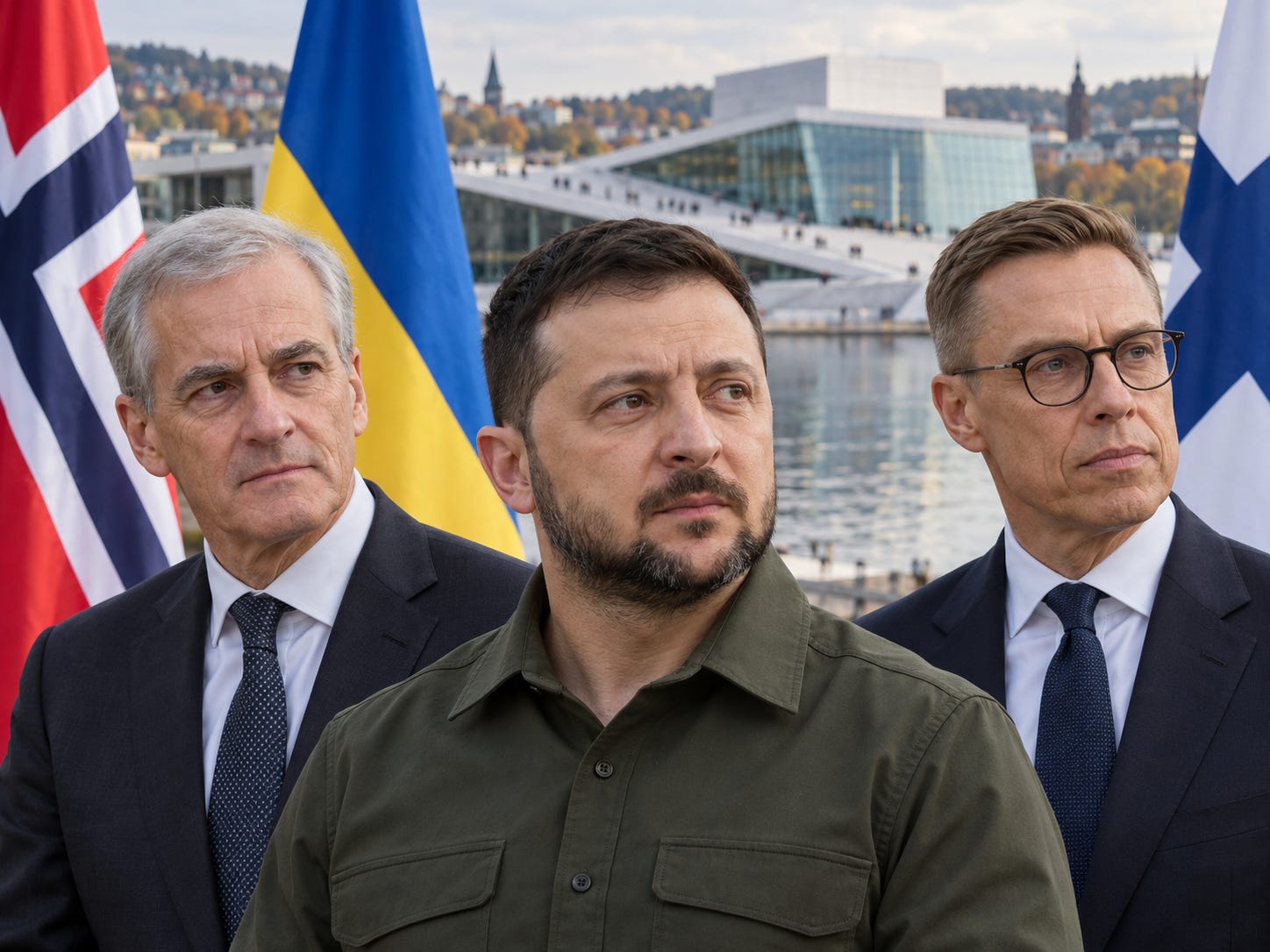
Ukrainian President Volodymyr Zelenskyy asked Norway and Finland to bring the parties together for talks on the war. On 20 October, he met Norwegian Prime Minister Jonas Gahr Støre and Finnish President Alexander Stubb in Oslo to develop proposals for a peace settlement.
US President Donald Trump was represented by Special Envoy Steve Witkoff. Fellow envoy Jared Kushner joined remotely from the United States. According to the Norwegian Prime Minister’s Office, the discussions covered Ukraine’s security, territorial questions and post-war reconstruction.
Security guarantees in a document
At their joint press conference, Zelenskyy said different models for security guarantees had been set out in a written document. He referred to the NATO defence alliance and guarantees modelled on its Article 5 provision for collective defence.
Witkoff was due to take the proposals to Russian officials in St Petersburg the following day. Ukraine would then receive a briefing on those discussions.
According to the Ukrainian President’s Office, the American representatives affirmed that the guarantees needed to be strong. The statements described proposals for further discussion with Russia.
For Zelenskyy, the aim was to secure a meeting between the leaders of Ukraine, the United States and Russia. He argued that sensitive territorial questions required decisions at the highest political level.
Støre wants Europe at the table
Støre linked the talks to Europe’s own security. At the press conference, he said European countries had played too limited a role in the process and needed greater influence over the settlement of a war on their continent.
The prime minister also defined the Nordic hosts’ mandate. He and Stubb were speaking for Norway and Finland. Both countries share a border with Russia and have a direct interest in stability in their neighbourhood, the two leaders emphasised.
National security advisers from the European Union (EU) and NATO joined the working dinner. The United Kingdom, Germany and Italy were also represented, according to the Norwegian Prime Minister’s Office.
Stubb distinguished between long-term proposals on security and the economy and measures that could make a difference quickly. Air defence and partial ceasefires covering energy and food security were among the subjects discussed, according to the press conference and the Ukrainian account.
Zelenskyy offered a reciprocal halt to attacks on sensitive parts of the two countries’ energy sectors. According to the Ukrainian president, Russian President Vladimir Putin had rejected the proposal while Russian attacks continued.
Air defence on Norway’s agenda
Protection against Russian attacks remained central throughout Zelenskyy’s visit. On his way to Oslo, he had already spoken with US Secretary of State Marco Rubio about satellite communications, air defence interceptors and intelligence.
At the press conference, Zelenskyy confirmed that the early-warning system for ballistic missile attacks was working. He was awaiting further follow-up on Starlink and missiles for the American Patriot air defence system.
On 21 October, he met Støre, Norwegian Defence Minister Tore O. Sandvik and representatives of Kongsberg. The Ukrainian President’s Office said they discussed further cooperation on the Norwegian-American NASAMS air defence system.
The office also described Norwegian participation in FREYJA, a European project to defend against ballistic missiles. The ambition was to bring selected components to testing by the end of 2026. New satellite communications capabilities were another subject.
Finland supports Ukrainian control
The following day, Finnish Prime Minister Petteri Orpo visited Kyiv. Ukraine’s Ministry of Defence and the Finnish companies ICEYE and Nokia signed a letter of intent on satellite communications.
The agreement will explore how Ukraine can build communications systems under its own control. Both the Ukrainian President’s Office and the companies’ press release confirm the cooperation.
The companies envisage systems in which countries own and control the satellites, ground infrastructure and terminals. The first communications satellites in their joint programme are expected to launch in 2028. The companies describe the system as a complement to existing military and commercial networks.
Waiting for air defence missiles
On 23 October, Zelenskyy outlined the next diplomatic steps during an online event hosted by the American think tank Hudson Institute. Negotiating teams from Ukraine, the United States and Russia were expected to meet in the first half of November. According to his office, he wanted European participation in the process, followed by talks between the leaders.
The following day, he announced that Starlink and Starshield were again operating at the speeds available before the restrictions. Ukrainian defence authorities had tested the satellite services.
Ukraine was still awaiting deliveries of air defence interceptors. Zelenskyy referred to both American and European packages that had already received political approval.
A possible meeting with American, European and NATO representatives in Brussels on 27–28 October was also announced. On 26 October, the arrangements remained uncertain. Presidential adviser Dmytro Lytvyn cited changes to American plans in a response to journalists reported by European Pravda.
Discussion about this post