Trump wants to spare Putin’s refineries. Can the Kremlin pressure him?
Trump’s ties, from a Moscow hotel invitation to a Putin-honoured boxing boss’s wedding gift, have Europe asking who influences him.

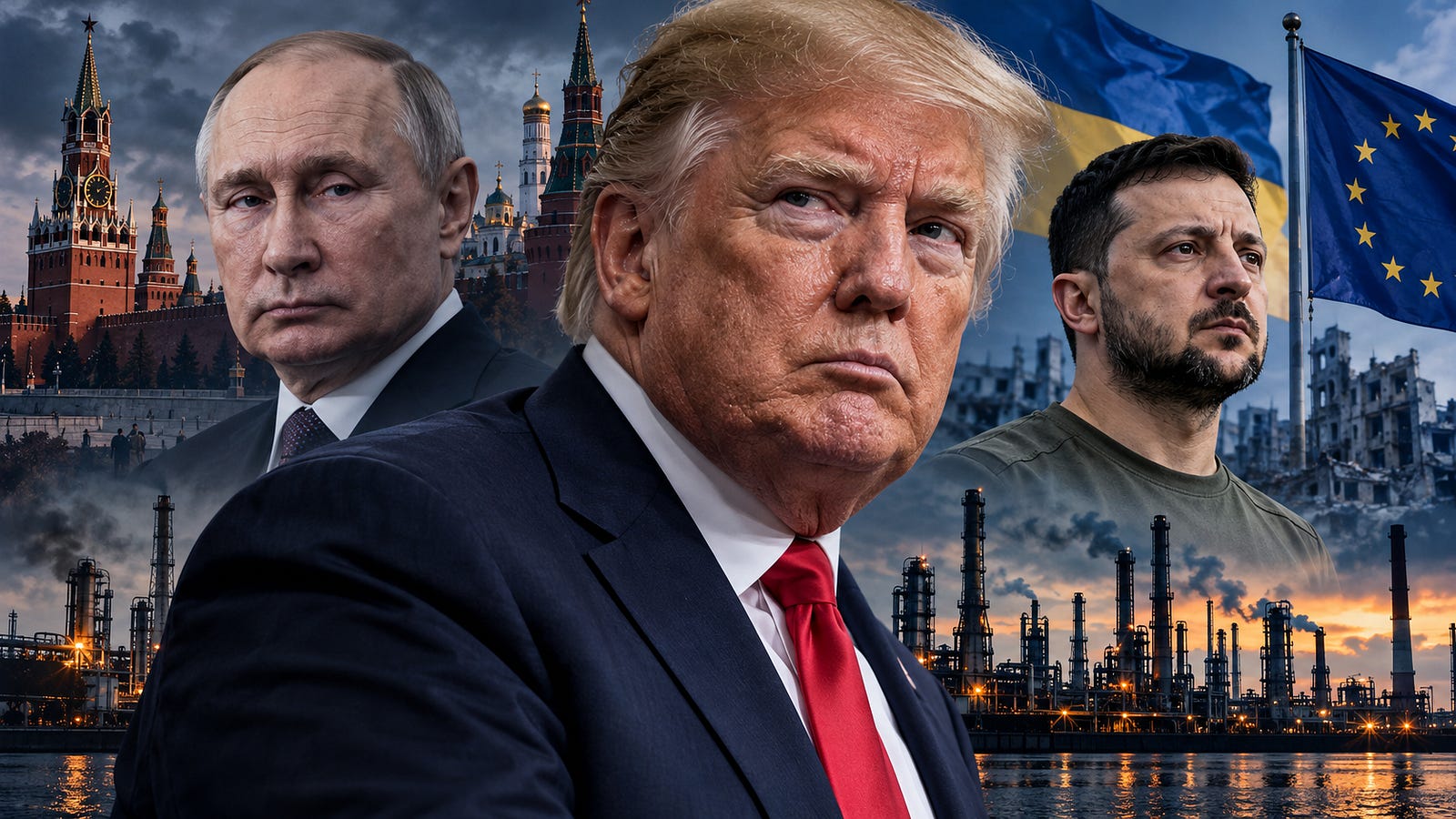
Donald Trump criticised Volodymyr Zelenskyy on Thursday evening in an interview with Newsmax. The president was asked whether he had told Ukraine to stop its attacks on Russian refineries, and confirmed the demand. The attacks were driving up oil prices, he said, calling them “a disgrace”. He then described Ukraine’s president as harder to negotiate with than Vladimir Putin. The remarks came ahead of Zelenskyy’s meeting with European leaders in Brussels.
On Friday, Kremlin spokesman Dmitry Peskov said that Moscow fully shared Trump’s assessment of Zelenskyy’s lack of will for peace. The day before, Sergei Lavrov, Russia’s foreign minister, had called the Ukrainian attacks a direct challenge to Trump. Russian officials thus presented attacks on their own oil industry as an attack on the American president’s authority.
The political support follows an economic opening. On 9 October, OFAC, the sanctions office of the US Treasury Department, issued a licence for trade in Russian diesel, including imports into the US, until 7 April 2027. Trump is opening the market for the fuel while trying to shield the facilities that produce it. Both benefit Russia’s oil economy, and Russian diesel exporters can now point to an American licence that lasts through the winter.
The picture is not clear-cut, however. In October 2025, Trump’s administration imposed sanctions on Rosneft and Lukoil, which any overall assessment of Russian influence must take into account. Even so, the diesel deal raises a security question for Europe that extends beyond fuel prices: Can the Kremlin use the president’s financial ties or private vulnerabilities to influence American decisions?
Moscow offered business and recognition
In 1987, Soviet ambassador Yuri Dubinin invited Trump to Moscow to discuss a hotel project. Trump travelled in July with Ivana. In his own book, he described site visits and the possibility of building in the Soviet capital.
Former KGB officer Yuri Shvets has given a different explanation. He told journalist Craig Unger, and later The Guardian, that Soviet intelligence had identified Trump as susceptible to flattery and political ambition. Shvets linked the interest to an earlier business contact through the electronics store Joy-Lud, and claimed that General Ivan Gromakov was behind the invitation.
Two months after the trip, Trump bought full-page ads in three American newspapers. He demanded that, among others, Japan and Saudi Arabia pay for American protection. According to Shvets, an internal KGB reportcelebrated the ads as a successful influence result. The original document has not been presented.
Former Kazakh security chief Alnur Mussayev went further in February 2025. He claimed that the KGB recruited Trump in 1987 under the codename Krasnov. Mussayev has made the claim publicly, but neither the recruitment report, the handling officer nor the registration has been publicly confirmed.
The money also reached the Trump family’s door
The financial ties began before the Moscow trip. David Bogatin bought five apartments in Trump Tower in 1984. He was later convicted in a large-scale fuel tax fraud case, and US authorities seized the apartments. The purchase, and Trump’s alleged participation at the closing, became a matter for the New Jersey gaming authorities, who in 1992 recommended asking Trump about the relationship under oath. The transactions document an early financial connection, while Trump’s knowledge of the origin of the money is a separate question.
Russian buyers continued to invest in Trump-branded properties. Reuters identified in 2017 at least 63 buyers with Russian passports or addresses in seven buildings in South Florida. Several were licensing projects in which Trump profited from the use of his name. As early as 2008, Donald Trump Jr. said the family was seeing a lot of money pouring in from Russia. The property deals show commercial connections, but a Russian state-run financing operation would require further documentation.
During the presidential campaign, Trump’s own interest became more direct. Attorney Michael Cohen negotiated Trump Tower Moscow until about June 2016. On 20 January, he spoke for around twenty minutes with an assistant at Peskov’s office about land and financing. Trump received updates while he was fighting to become president of the United States.
Cohen later told Congress that the project had ended in January. In 2018, he admitted that the timeline was false. The private Moscow business had continued for months of the campaign. The Senate Intelligence Committee assessed that senior Russian officials, almost certainly including Putin, knew of the project by January 2016. Russia thus held knowledge of a private interest that the public account concealed, which is a potential vulnerability.
The family opened several channels
Ivanka Trump received an approach in November 2015 from Lana Erchova, who arranged contact with Dmitry Klokov. Ivanka asked Cohen to follow up. Klokov offered an informal meeting with Putin and described how political contact could open larger business opportunities. The emails were copied to Ivanka.
The following year, Donald Trump Jr. received an offer of incriminating information about Hillary Clinton. Rob Goldstone presented the offer as part of the Russian government’s support for his father’s candidacy. Trump Jr. replied that he loved it if the description was accurate. On 9 June 2016, he met the Russian participants together with Jared Kushner and Paul Manafort. Robert Mueller’s investigation documented the contacts and the Russian election interference, but concluded that coordination between the campaign and the Russian government’s election operation had not been established.
Manafort opened another channel of information. On his orders, Rick Gates sent internal campaign polling data to Konstantin Kilimnik. American financial authorities stated in 2021 that Kilimnik passed sensitive polling and strategy information to Russian intelligence. In December 2016, Kilimnik also asked for a signal from Trump about a Ukraine plan and enticed Manafort with higher status and business opportunities. Documentation that Trump received or approved the plan is lacking.
Intelligence services’ interest also extended to the family earlier in Trump’s life. Czechoslovakia’s secret police, the StB, registered Ivana’s father, Miloš Zelníček, as a trusted contact and collected information about the children, their travels and Trump’s political ambitions. Historian Petr Blažek, who has examined the archives, limits the finding to documented information gathering. A specific KGB assignment remains an open question.
For Melania Trump, there are two different tracks. In a 2019 FBI interview, a witness whose name is redacted stated that Jeffrey Epstein introduced her to Trump. Melania publicly rejected this in April and said the couple met at a party in 1998. The interview records a statement about the introduction, but the witness’s basis of knowledge is unclear. The other track is less dramatic: After a phone call between Trump and Putin on 16 October 2025, Putin’s adviser Yuri Ushakov said that Putin had thanked Melania for her work on reuniting children and families. This shows that the first lady has a role in the contact between the president’s family and Russian leadership. The claim that she was placed by an intelligence service requires evidence of its own.
The Putin connection that ended in a wedding gift
A more recent financial connection runs through Umar Kremlev, president of the International Boxing Association (IBA). In April, he received the Order of Friendship from Putin. As early as 22 January 2025, he had written to Trump asking for help in the dispute with the International Olympic Committee, including over boxing at the 2028 Los Angeles Olympics. In September 2025, Trump Jr. attended an IBA event in Istanbul and gave Kremlev public support.
In May, Kremlev paid for parts of the wedding celebration of Trump Jr. and Bettina Anderson in the Bahamas. ProPublica revealed in September that the expenses amounted to several hundred thousand dollars, and the couple confirmed that he had financed two party nights after the ceremony. Democrat Robert Garcia then demanded payment records, guest lists and communications with the White House. Republican Senator John Curtis also called for scrutiny. On 6 October, Kremlev said that Trump Jr. had repaid the money. Payment receipts and the full contact log are still being sought.
The hunting circle around Trump Jr. offers an additional lead. Kaan Karakaya, who runs Shikar Safaris, was listed as host together with Trump Jr. for a hunt in an American auction catalogue from January 2025. Later that year, Kremlev appointed him IBA’s representative in Turkey. The connections to both circles are documented, while Karakaya’s possible role in the introduction and the wedding gift is unresolved.
Around chief of staff Susie Wiles, too, political access is being bought. Continental Strategy, where her daughter Katie Wiles is a partner, has a lobbying agreement with Republika Srpska. Partner Alex Garcia organised the meeting between Susie Wiles and the Bosnian Serb politician Željka Cvijanović at the White House in September. The agreement documents paid government contact, while the question of who, if anyone, directs the connection further is a matter for separate investigation.
A Russian wish and an American response
The clearest direct link between a Russian wish and an American position concerns the Tomahawk missiles. During the phone call on 16 October 2025, Putin, according to the Russian side, warned against American deliveries to Ukraine. Trump confirmed the opposition, and in early November he responded dismissively when asked whether he was considering deliveries. Diplomatic pressure is one possible explanation, and personal blackmail would require further evidence.
The president’s price argument meets Europe’s security
Trump’s public justification for the diesel deal is lower energy prices. The claim that the Kremlin is pressuring him remains a hypothesis. But the Moscow negotiations, Cohen’s lie, the campaign contacts and the more recent family connections give concrete reasons to examine what means of influence Russia may have.
On Friday, EU Council President António Costa stood beside Zelenskyy and called for stronger support for Ukraine and increased pressure on Russia. At the same time, Trump had told Ukraine to choose other targets than Russian refineries. Washington’s decisions thus affect one of Kyiv’s tools against the economy behind the invasion.
Congress has already requested the presidential family’s payment records and contact logs. Now the communications behind the diesel deal and the pressure on Ukraine are also central: Who advanced the demands, what conditions were discussed, and what considerations decided the president’s choice? The answers will show more about how Russian interests gained traction in American politics.
Discussion about this post