Trump and Putin: Four Decades of Russian Ties
A young developer courted Moscow for a hotel deal; now his energy decisions leave Washington asking whose interests they serve.

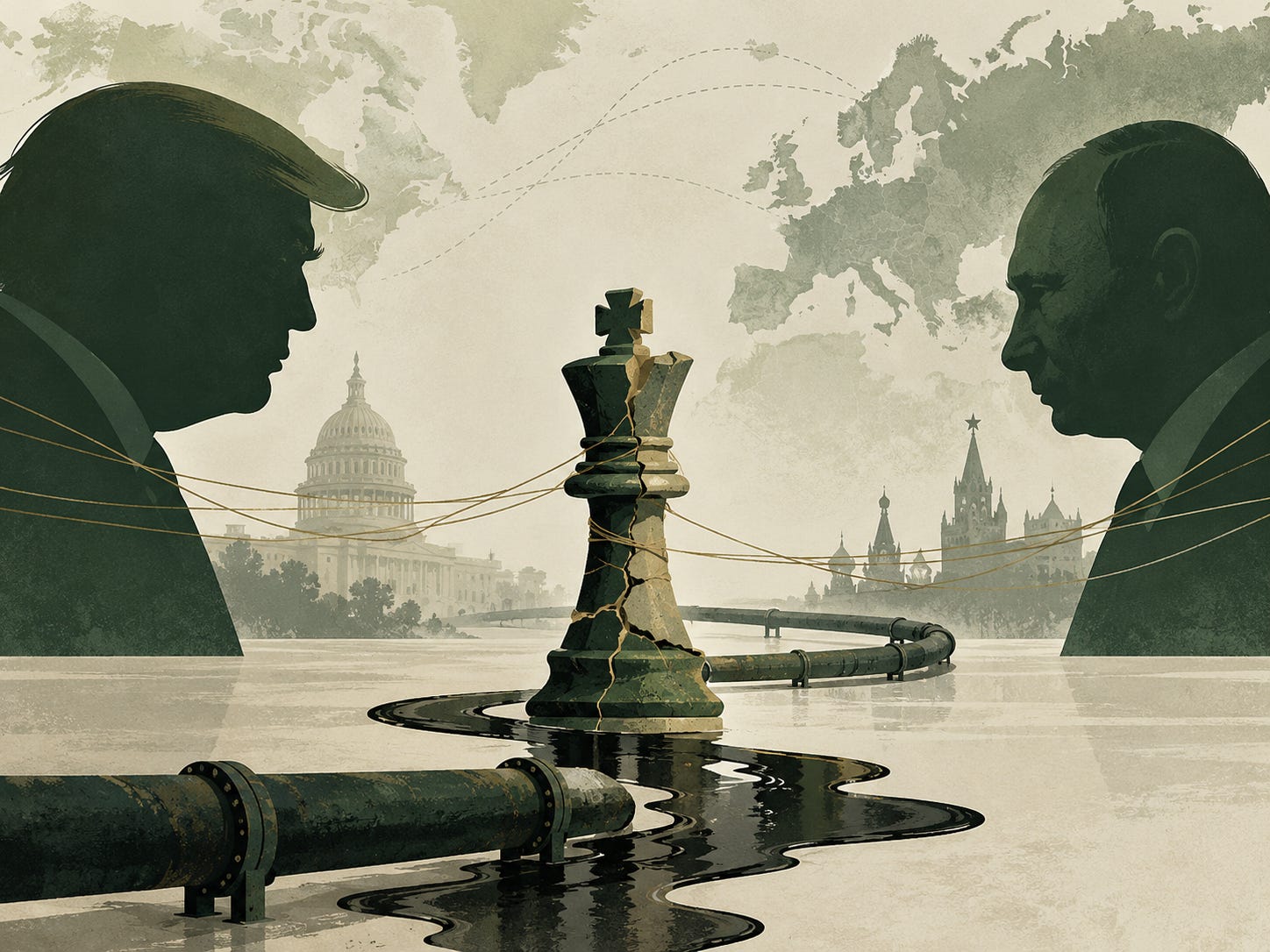
WASHINGTON / MOSCOW, Oct. 18, 2026 — President Donald Trump this month opened the door to more Russian diesel exports and postponed new sanctions on Russia, even as Vladimir Putin presses his war in Ukraineand hunts for revenue. Mr. Trump says high energy prices and the need for negotiations justify the course. The decisions also pull attention back to a relationship that began almost 40 years ago, when a brash New York developerflew to Moscow at the invitation of Soviet officials.
The story is bigger than two leaders. It spans real estate fortunes, secret business talks, contacts with Russian intelligence circles and a 2016 campaign that Moscow tried to tilt. American authorities have documented many of these links. What they have not produced is public evidence that the Kremlin controlled Mr. Trump or dictated his decisions.
Moscow, 1987
In July 1987, Mr. Trump visited the Soviet capital after contact with Ambassador Yuri Dubinin, hoping to build a luxury hotel. Soviet officials smoothed the way. To Moscow, the developer was a conduit to American capital and publicity; to Mr. Trump, a state-controlled market.
Weeks later he bought full-page advertisements in three major newspapers, arguing that the United States wasted money defending allies who should pay their own way. It was an early draft of his later attacks on NATO. The ads record his views; they do not tie them to Soviet instructions.
Former KGB officers have since claimed the agency cultivated him, and some say he was recruited. Those claims have drawn wide attention but lack verifiable documentation. The firmer trail is commercial.
Russian money in Trump towers
After the Soviet collapse, Russian fortunes flooded Western property markets. The Trump Organization sold to many of the buyers. At a 2008 conference, Donald Trump Jr. said Russians made up a disproportionate share of buyers in the family’s projects.
A Reuters analysis in March 2017 found at least 63 buyers with Russian passports or addresses in seven Trump-branded buildings in South Florida, with purchases worth $98.4 million. Reuters did not find that the money came from the Kremlin. Still, the sales show how deeply Russian capital was woven into his business long before politics.
Another associate was Felix Sater, a Russian-born developer with a prior conviction for securities fraud, who worked on Trump projects through Bayrock Group and later helped drive Trump Tower Moscow.
A hotel deal in the middle of a campaign
In the fall of 2015, as Mr. Trump led the Republican primary, his lawyer Michael Cohen and Mr. Sater were pushing the Moscow tower. In a Nov. 3, 2015, email to Mr. Cohen, Mr. Sater boasted that he could get Putin’s people behind the project and that it could help Mr. Trump win the presidency.
Talks ran into June 2016. Mr. Cohen contacted the office of Dmitri Peskov, Mr. Putin’s spokesman, while Mr. Trump publicly played down his Russian business. Mr. Cohen later admitted lying to Congress about how long the talks lasted, according to the Mueller report, the special counsel’s investigation into Russian election interference.
That created a vulnerability: people in and around the Russian government knew of dealings the American public did not. In principle, that is leverage. Mr. Mueller’s team documented the secrecy and the false statements but did not establish that Mr. Putin used them to pressure Mr. Trump.
Russians also tried to get closer to the campaign. In June 2016, Mr. Trump Jr. was offered damaging material on Hillary Clinton, pitched as Russian government support for his father. He answered eagerly and attended a Trump Tower meeting with Paul Manafort and Jared Kushner.
Mr. Manafort, then running the campaign, kept in touch with Konstantin Kilimnik, whom American authorities tie to Russian intelligence. The Republican-led Senate Intelligence Committee called the contacts a serious counterintelligence threat, and the Treasury Department said Mr. Kilimnik passed sensitive campaign information to Russian intelligence.
American intelligence agencies concluded that Mr. Putin ordered an influence operation to hurt Mrs. Clinton and help Mr. Trump, using hacking, leaks and online campaigns. Robert Mueller found extensive Russian interference but did not establish a criminal conspiracy between the campaign and the Russian government. The line matters: Russian efforts to help Mr. Trump are documented; a secret deal to steer his policy is not.
Helsinki and Alaska
On July 16, 2018, in Helsinki, Mr. Trump stood beside Mr. Putin and, asked about election interference, cited the Russian leader’s denial and questioned his own intelligence agencies. The backlash included Republicans. The next day he tried to walk back a key phrase.
The record is mixed. His first administration approved Javelin anti-tank missiles for Ukraine, which Russia opposed.
Back in office, Mr. Trump received Mr. Putin in Alaska on Aug. 15, 2025, with a red carpet and a military ceremony. No cease-fire followed. Afterward, Mr. Trump shifted from demanding a cease-fire first to favoring a comprehensive peace agreement, which suited Mr. Putin’s preference for a broader settlement.
The boxing chief and the wedding
In spring 2026, ProPublica reported that Umar Kremlev, a Russian boxing executive with close ties to Mr. Putin, paid for much of Mr. Trump Jr.’s wedding celebration in the Bahamas. The cost was reportedly several hundred thousand dollars, routed through a company linked to the International Boxing Association in Dubai.
Mr. Kremlev had lobbied President Trump on boxing’s future and appeared publicly with his son. In October, Mr. Kremlev said the money had been repaid but offered no documentation. Nothing shows a quid pro quo. But the episode shows how figures from the Russian elite reached the president’s family.
Diesel and delay
On Oct. 9, Mr. Trump announced a deal with Mr. Putin to increase Russian diesel supplies to world markets, citing a first shipment of more than 300,000 tons, with larger volumes to follow. Reuters reported that exports began within days. The administration said the aim was to calm energy prices after turmoil in oil markets.
Energy exports remain a pillar of Russia’s war economy. Ukraine has struck Russian refineries to squeeze it; Mr. Trump criticized the attacks, pressed Kyiv to stop and described President Volodymyr Zelensky as harder to deal with than Mr. Putin. Mr. Zelensky has warned against giving Russia new revenue while the war goes on.
On Oct. 16, Mr. Trump signed an executive order delaying key provisions of sanctions legislation championed by Senator Lindsey Graham, aimed at Russian war financing and foreign buyers of its energy. Secretary of State Marco Rubio said the administration needed time to weigh the economic effects. Existing sanctions under other authorities remain.
The administration points to energy prices, economic stability and diplomatic openings. For Moscow, the effect is concrete: more revenue, more market access, less immediate pressure. The decisions show an overlap between American policy and Russian interests. They do not, on their own, reveal motive.
At the Baltic port of Primorsk, a Russian diesel cargo of about 40,000 tons was logged heading for Morocco, according to Reuters. As Western leaders debated how to weaken Mr. Putin’s war economy, Russian fuel was again moving to buyers, and Mr. Putin had a fresh chance to sell one of the goods Russia depends on most.
Discussion about this post