Thailand’s Queen Flew a Swedish Gripen, While the Nordic Countries Chose American F-35s
The solo flight puts the fighter jet choices made by Norway, Finland and Denmark in the spotlight, along with their dependence on the United States.

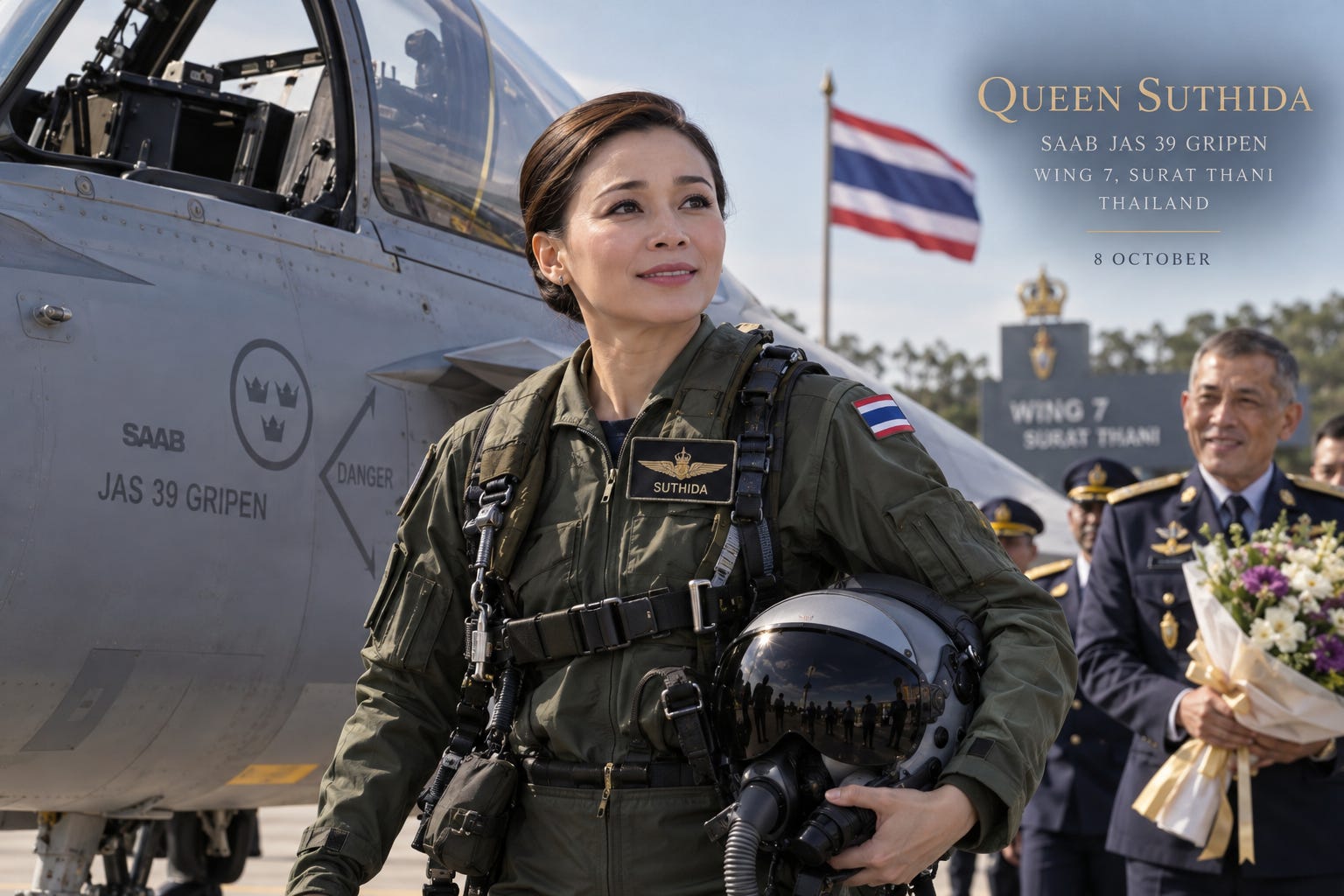
SURAT THANI, THAILAND – Queen Suthida Bajrasudhabimalalakshana flew solo in a Swedish-built Saab JAS 39 Gripen on Thursday, October 8. She started the engine, taxied onto the runway and took off from Wing 7 Air Basein southern Thailand. When she landed 41 minutes later, she had made history in Thailand’s military aviation.
The Queen has more than 1,188 flight hours to her credit and had completed specialised training on the Swedish fighter jet. Before her solo flight, she trained with an instructor in the two-seat Gripen D. For the flight itself, she piloted the single-seat Gripen C alone.
King Maha Vajiralongkorn watched the flight from the ground and presented her with flowers after she landed, according to The Nation Thailand. Swedish aircraft manufacturer Saab was quick to congratulate her, highlighting the confidence Thailand places in its Gripen fleet.
A Bigger Story Behind the Ceremony
The event comes against the backdrop of a broader debate over European fighter jet procurement. Thailand has decided to continue investing in Swedish fighter aircraft. In August 2025, the country ordered four new Gripen E/Fjets worth approximately 5.3 billion Swedish kronor.
Meanwhile, three Nordic countries with much closer military ties to Sweden have chosen the American F-35 Lightning II. Norway has purchased 52 aircraft and Finland 64. Denmark has built its new fighter fleet around the F-35.
That raises the question of why these countries chose American aircraft when an alternative was being developed in their own neighbourhood.
Norway: Gripen Considered Too Weak
Norway selected its new fighter aircraft in November 2008. The competition was between Lockheed Martin’s F-35and Saab’s Gripen NG, the predecessor of today’s Gripen E.
According to the Norwegian government’s official website, regjeringen.no, the government concluded that the F-35offered better sensors, a greater ability to operate without being detected, and superior electronic warfare capabilities. Gripen was considered inadequate for several of the most demanding scenarios involving the defence of Norwegian territory.
The government also believed the F-35 would have lower acquisition and lifetime costs. That was the conclusion of the calculations at the time, before the programme’s subsequent cost increases and delays.
Norway therefore selected an aircraft designed to penetrate modern air defence systems and strike heavily protected targets. In a hypothetical confrontation with Russia, precisely that capability was considered decisive.
The decision also had a security policy dimension. For decades, Norway had built its Air Force around American technology and close cooperation with the United States.
Finland: Chose the F-35 Despite Gripen’s Strengths
For Finland, Gripen should have been a particularly strong contender. The country shares a long border with Russia, has a defence system built around national mobilisation, and places great importance on its ability to continue fighting even if air bases and infrastructure come under attack.
Gripen was developed with precisely these conditions in mind. The aircraft can operate from dispersed bases, including suitable stretches of road, and is designed for efficient maintenance and rapid turnaround between missions.
Nevertheless, Finland chose the F-35 in December 2021. The country had evaluated five different fighter aircraft systems. Saab’s offer included not only Gripen, but also a cooperation package incorporating the GlobalEye airborne surveillance aircraft.
According to the Finnish Ministry of Defence, the F-35 offered the best overall military capability, particularly in combat effectiveness, reconnaissance and survivability. Finland also assessed security of supply and opportunities for domestic maintenance before ordering 64 aircraft.
The outcome suggests that Gripen’s ability to operate from dispersed bases did not necessarily outweigh the F-35’stechnological advantages. It also reflects the importance Finland placed on American military technology, just months before Russia launched its full-scale invasion of Ukraine.
Denmark: Gripen Never Reached the Final Round
Denmark selected the F-35 in June 2016, following a competition that ultimately came down to three American and European contenders: the F-35, Boeing Super Hornet and Eurofighter Typhoon.
Sweden had originally been invited to participate with Gripen, but withdrew the aircraft from the process in 2014. Danish authorities therefore never received a final Gripen bid to compare with the remaining candidates.
According to the Danish Ministry of Defence (fmn.dk), defence officials considered the F-35 the strongest option in both technological and operational terms. Cooperation with other F-35 operators was an important part of the rationale.
A Shared Solution, a Shared Dependence
Norway, Denmark and Finland have now tied a crucial part of their air defence capabilities to the same American-led aircraft programme. This brings significant military advantages. The countries can train together, share experience and build a common operational environment around the same aircraft type. But the arrangement also creates a shared dependence.
The question of dependence on the United States has taken on new significance under President Donald Trump. Washington has pressed European NATO members to spend substantially more on defence, while American foreign policy has raised uncertainty about how predictable the relationship will remain in the longer term.
The F-35 is more than a fighter jet. It is part of an extensive American-led system covering software, spare parts, maintenance, weapons and technological upgrades. Norwegian, Danish and Finnish authorities exercise national control over their aircraft, but they also depend on an international framework in which the United States plays a dominant role.
In 2025, a debate emerged over whether Washington could disable European F-35s through a secret electronic switch. Finnish Air Force Commander Timo Herranen told Yle that no such “kill switch“ exists.
A digital shutdown mechanism, however, is only one possible form of dependence. If access to software updates, spare parts and technical support were restricted over time, it could affect how long the aircraft could maintain their full operational capability. That is a more concrete concern than the notion that Washington could ground the jets at the press of a button.
Sweden: Greater Control Over Its Own System
Gripen emerged from a different military tradition. Sweden developed its own fighter aircraft while the country was still outside NATO. The Swedish Air Force needed to be able to survive attacks on major air bases and continue operations from smaller, dispersed locations.
Through Gripen, Sweden has retained domestic expertise in aircraft development, systems integration, maintenance and the continued evolution of its fighter fleet.
Gripen also depends on foreign technology. The engine in the latest Gripen E is American-made, and the aircraft contains several other American components. Choosing a Swedish aircraft would therefore not have made the Nordic countries completely independent of the United States. Nevertheless, Sweden exercises greater direct control over the development and integration of its fighter aircraft system than the Nordic F-35 operators.
On Thursday, October 8, the same day the Thai Queen flew Gripen, Saab announced a new partnership with GKN Aerospace. The aim is to strengthen Swedish expertise and capacity related to the engines used in the Gripen E/F, thereby reinforcing the country’s domestic defence industrial capabilities, according to GKN Aerospace.
Two days earlier, the first Gripen E aircraft manufactured in Brazil had completed its maiden flight. Production in Brazil demonstrates how Saab can combine fighter aircraft exports with technology transfer and the development of local industrial expertise, according to Saab.
These developments add a dimension to the fighter jet debate that extends far beyond the question of which aircraft would prevail in aerial combat.
The Decisions Have Been Made, but the Question Remains
Norway, Finland and Denmark chose the F-35 because their defence authorities considered it the aircraft that best met their military requirements. The decisions were made in 2008, 2021 and 2016, respectively, under different security policy conditions from those Europe faces today.
Since then, Sweden and Finland have joined NATO. The Nordic countries have gained far greater opportunities to coordinate their air defence, while Russia has demonstrated how crucial access to industry, ammunition, spare parts and repair capacity becomes during a prolonged war.
A joint Nordic Gripen programme could have provided different opportunities for development, production and national control. At the same time, the countries would have had to accept differences in military capability, particularly regarding the F-35’s ability to operate against modern air defence systems.
Queen Suthida’s solo flight does not settle that debate. But she flew an aircraft built by a small Nordic country that has spent decades preserving its own expertise in developing and maintaining advanced weapons systems.
For Norway, Finland and Denmark, one question therefore remains — and it cannot be answered by stealth technology or an aircraft’s top speed: How much military dependence on an ally can a country accept before that dependence itself becomes a security risk?
Discussion about this post