Russian Fish Still Flows into Europe
Russian fish continues to enter Europe aboard Norwegian ships as Dutch Customs cites limits on its mandate and questions about the suppliers’ ownership remain open.

Dutch Customs spokesperson Oscar van Elferen confirmed to The New Backyard on October 20 that Russian fish generally remains eligible for import into the European Union. Certain luxury products, including caviar, face separate restrictions.
Responding to The New Backyard’s investigation, he said sanctions checks specifically targeting Russian fish fall outside Customs’ mandate because the product itself generally remains permitted.
At the same time, he said ownership involving sanctioned individuals and companies forms part of Customs’ risk analysis.
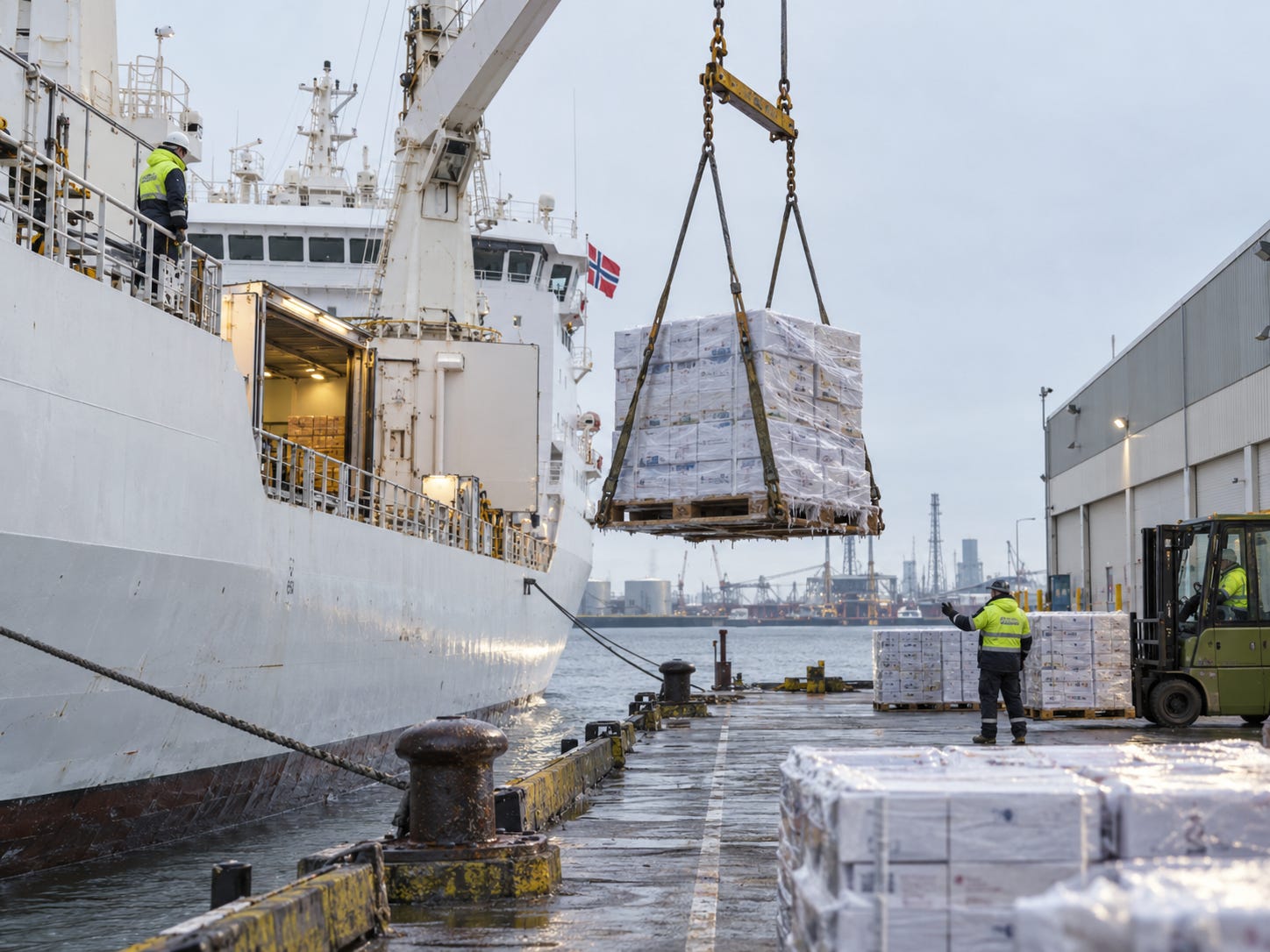
The response leaves open which checks were performed on a shipment of nearly 646 metric tons carried from Murmansk, Russia, to Velsen, the Netherlands, aboard the Norwegian-registered refrigerated cargo ship SILVER DANIA in May.
Asked whether authorities had examined the suppliers’ owners, controlling interests and payment beneficiaries, Customs invoked its policy on individual cases.
For broader ownership investigations, the agency pointed to several possible authorities, including the Netherlands’ Fiscal Information and Investigation Service (FIOD), which investigates financial crime.
“The competent authority depends on the specific case and subject matter,” van Elferen wrote.
Three ships carried more than 1,156 metric tons
The New Backyard’s October 13 investigation documented 1,156,044 kilograms of Russian fish shipped from Murmansk to the Netherlands aboard the Norwegian-registered vessels SILVER DANIA, SILVER BIRD and SILVER CRYSTAL in April and May.
All three shipments passed through the same European import chain. Sirena Group A/S, a Danish seafood trader, appeared as importer. Daalimpex Velsen B.V., a Dutch company, acted as the importer’s representative.
The documents establish the cargoes’ origin, weight and route. The ownership trail raises a further question: who ultimately receives the proceeds?
Around 613 metric tons aboard SILVER DANIA came from the Russian suppliers Virma, Soglasie and Rybotorgovaya set’. Together, they accounted for almost 95 percent of that shipment.
The ownership trail leads into a Russian fund
Our investigation linked those suppliers to Dal, a Russian closed-end investment fund managed by the investment company Svinin & Partners.
The companies also have historical connections to Igor Zubarev, a Russian senator sanctioned by the EU in 2022.
Those connections make the fund’s present ownership important. Whether the senator retains an ownership interest, exercises control or benefits financially from these transactions remains an open question.
EU financial sanctions can extend to companies owned or controlled by sanctioned individuals. Payments that indirectly benefit a listed person can also fall within the restrictions, depending on the circumstances.
Another part of the investigation follows Melkart Fish LLC, an Uzbek trading company registered in Tashkent, which appears in all three documented shipments.
A transfer document identifies Melkart as the seller of Russian-caught haddock delivered at a warehouse in Murmansk. The company adds another trading layer between Russian fishing vessels and the European market.
Norwegian ships carried the fish onward
The route has already adapted to restrictions on Russian shipping.
In 2024, around 2,000 metric tons of frozen fish were transferred from the Russian refrigerated cargo ship BELOMORYE to Norwegian SILVER COPENHAGEN at Bellsund, Svalbard, after the Russian vessel lost access to Dutch ports.
The Norwegian ship carried the cargo onward to the Netherlands.
In May 2025, the EU sanctioned Norebo, the Russian fishing group associated with BELOMORYE, and Murman SeaFood, another Russian fishing company, citing state-sponsored surveillance activities targeting critical infrastructure. Norway followed in July. The documented 2026 cargoes name other suppliers.
Vessel tracking examined for our October investigation showed SILVER DANIA sailing from Murmansk to the Netherlands again in September. Documentation of the cargoes on later voyages remains part of the investigation.
In Norway, the Directorate for Export Control and Sanctions (DEKSA) is considering questions about Norwegian carriers’ responsibilities. Kaja Haldorsen, the Norwegian agency’s head of communications, said on October 16 that it would return with an answer the following week.
Discussion about this post