“Russia Is Not My Enemy”: How a Slogan Spread Across Europe
It began with posters in Verona. Then it became a wave online. Now the message is turning up in posts from Italy to Finland.

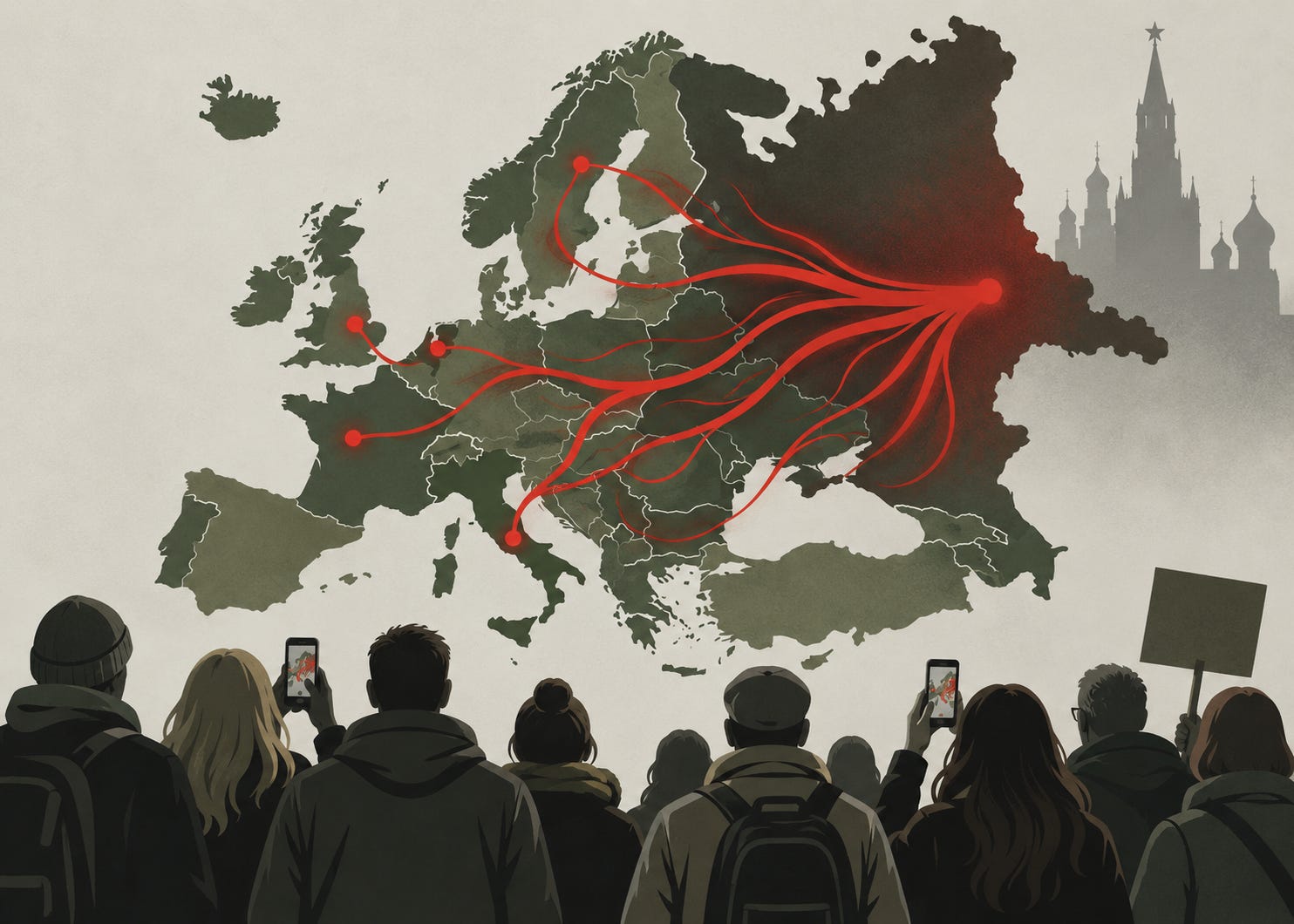
In the summer of 2024, large posters appeared in the Italian city of Verona reading “La Russia NON è il mio nemico” – “Russia is not my enemy.” It looked like a local affair. Two years on, the slogan has travelled across the continent.
In September 2026, people on X posted the same line in language after language: “I am Swedish, and Russia is not my enemy.” “I am Danish…” “I am Finnish…” “I am Norwegian…”
It sounds harmless, almost like a plea for peace. But behind the slogan lies a much larger system.
Russia Wants to Influence Europe
Russian influence operations are nothing new. The EU’s foreign service says Russian state actors use everything from diplomats and intelligence services to state media, private companies and local proxies to sway societies across Europe.
The Embassy Is Using the Slogan Itself
The clearest link leads straight to the Russian state.
On 1 September, Russia’s embassy in the Netherlands posted an image of a handshake in Russian and Dutch colours, with the message “Russia is not my enemy.” The embassy attacked what it called warmongers and used the Dutch hashtag #NietOnzeOorlog – “Not our war.”
That was several weeks before the big wave on X. And once the wave had taken off, the embassy jumped back in. On 25 September it called the campaign a “flash mob” and said it fully backed the message.
This does not prove the embassy started it all. But it makes it hard to describe the phenomenon as a purely grassroots movement.
From Verona to a Kremlin-Linked Network
The Verona posters were put up by three organisations, among them Associazione Veneto-Russia, a partner of the Italian branch of the International Russophile Movement.
This is no random circle of friends. In December 2025, the EU placed the entire organisation on its sanctions list. The EU says it spreads narratives on behalf of the Russian government, has close ties to the Russian foreign ministry, and is used by the Russian state as cover to influence public opinion in other countries. Foreign Minister Sergei Lavrov has given keynote speeches at its congresses. The network also has links to the Kremlin ideologue Aleksandr Dugin and the oligarch Konstantin Malofeev.
The head of the Italian branch, former Sputnik employee Eliseo Bertolasi, told a Russkiy Mir congress how the poster campaign had spread to other countries.
RT Behind the Scenes
Researchers at the Institute for Strategic Dialogue have examined how the sanctioned Russian outlet RT, formerly Russia Today, has continued to reach Italian audiences through local events and documentary screenings. Two Italian groups, Donbass Italia and Contronarrazione, promoted both RT screenings and the “Russia non è il mio nemico” campaign. ISD says this points to a coordinated effort.
The method is a familiar one: the message does not have to come from a Russian state account. Local groups, media outlets and activists do the work.
A Possible Spy Link
In December 2024, Italian senators raised the matter with their government. They cited a journalistic investigation into a Russian national described as an officer of the FSB, accredited as a journalist for “New Kuban.” He is alleged to have played a role in both designing and funding the poster campaign.
But this is an allegation contained in a parliamentary question. No court has established that the FSB paid for the posters. It is a possible lead, not a proven fact.
The Kremlin Has a Machine for This
That Russia runs organised influence operations in Europe is no longer in doubt. US authorities have exposed how the Russian companies Social Design Agency and Structura were behind the operation known as Doppelgänger, which used fake websites and social media accounts. According to the US Department of Justice, they worked under the direction and control of the Russian presidential administration, including Sergei Kiriyenko. The aim was, among other things, to weaken support for Ukraine. British authorities say Social Design Agency is directly funded and tasked by the Russian state.
What remains unclear is how far the chain of command can be traced into this particular campaign.
The Same Pattern in France
The French organisation SOS Donbass has used the same handshake motif and made “Russia is not my enemy” posters available to supporters. As early as 2024, it urged people to put up pro-Russian posters.
In November 2025, its founder Anna Novikova and several others were charged in France in an investigation into suspected contact with a foreign power and foreign interference. French authorities suspect the group of having organised poster campaigns. The case is still before the courts, and being charged is not the same as being convicted.
From the Netherlands to the North
By September 2026, the slogan had reached northern Europe. On X, the sentence moved from country to country: “I am Finnish,” “I am Danish,” “I am Swedish,” “I am Norwegian – and Russia is not my enemy.”
An analysis of the spread shows how Finnish, British, Danish and Swedish accounts quoted and adapted one another’s posts, almost like a relay race through national networks. Some accounts appear to belong to real people. Others have traits that make it unclear who is behind them.
The message was repackaged for each language and each country, but the sentence was the same from Verona to Helsinki.
One of the clearest individual examples came from Norway. On 24 September, Trude Helén Hole published her own Norwegian version. She says she made the image using artificial intelligence, and wrote that in her view the enemies are the UN, NATO, the EU, the World Economic Forum, the WHO, governments and the media – not Russia.
There is nothing to suggest Hole received instructions from Russia. And that is precisely the point: a message like this does not need to be steered from Moscow when people in Europe pick it up themselves, repackage it in their own way and pass it on to their own audiences.
Why It Works
This is where the threads come together. Russia has a state-run apparatus for influencing European public opinion. Diplomats take part. State media use local intermediaries. An organisation the EU believes works for the Russian government is tied to the circle behind the Italian posters. And the Russian embassy in the Netherlands is using the slogan itself.
Then local actors take over. Some have ties to Russian circles. Others share Russia’s views on NATO and Ukraine. Some come from anti-EU, anti-NATO, anti-vaccine or conspiracy-theory communities. And some simply believe the message is right.
It is this mix that makes the influence so hard to expose. Once a message has been planted, real people can spread it out of genuine conviction. The Kremlin does not need to control every poster, account or individual for the campaign to serve Russian interests.
What We Still Don’t Know
The picture is therefore clear: Russia is actively and systematically trying to influence public opinion in Europe, and “Russia is not my enemy” has spread through circles with direct links to Russian state institutions. The same message has now surfaced from Italy and France to the Netherlands and the Nordic countries.
Discussion about this post