Putin’s Useful Idiots Come from Norway
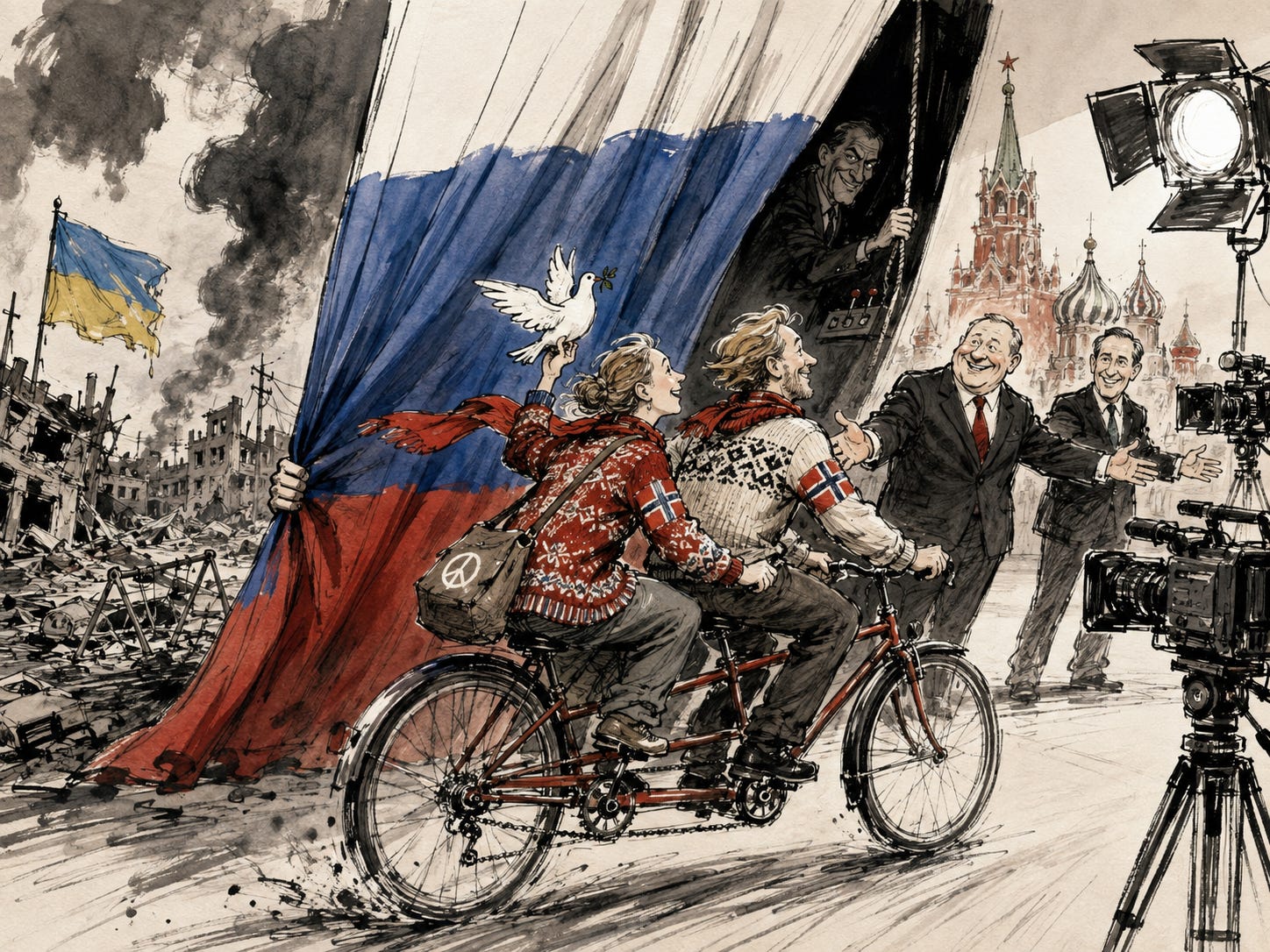
Russia uses every opportunity to excuse and legitimise its attack on Ukraine. Now Norwegian peace activists are voluntarily appearing as extras in the performance.

A Ukrainian woman is standing behind the reception desk at the Scandic Hotel in Kirkenes. She can hear the conversation between journalists and the Norwegian peace activist Tore Nærland.
“I’m from Ukraine. I’ve lost everything. I no longer have a home. This subject is too painful for me,” she says, asking them to continue the conversation somewhere else.
Nærland moves away. He then continues explaining why the West must also accept responsibility for the war.
The scene comes from an article published by The Barents Observer on 6 August. The newspaper met members of the Norwegian organisation Bike for Peace ahead of their latest journey to Russia. The activists had just collected their visas from the Russian Consulate General in Kirkenes.
The delegation consists of around ten Norwegians. Once again, they will meet Russian politicians and government officials. Their visits receive enthusiastic coverage from Russian media outlets including TASS, RIA Novosti, Tsargrad, Komsomolskaya Pravda and TV-21 in Murmansk.
It is not difficult to understand why.
From peace activism to Russian propaganda
Tore Nærland has devoted almost his entire adult life to peace activism. He founded Bike for Peace in 1977 and has organised peace journeys in more than 125 countries. He is almost completely blind, has studied history and political science, and has received both the King’s Medal of Merit and the Seán MacBride Peace Prize.
That background gives him authority. When such a man travels to Moscow and speaks about peace, Russian authorities can present him as an independent and morally credible voice from the West.
But Nærland does not use this position to hold those in power accountable. Instead, he repeats central elements of the Kremlin’s narrative.
He describes the change of government in Kyiv in 2014 as a coup supported by the United States and the CIA. He believes the West has helped prolong the war. He equates Russian attacks on Ukraine with Ukrainian strikes against military targets inside Russia. When asked directly, he refuses to describe Russia as a dictatorship.
Speaking about Vladimir Putin, he says:
“Putin has done a lot of good by making sure people have jobs in Russia.”
This is said after Russia attacked a democratic neighbour, occupied Ukrainian territory, deported children, bombed cities and imprisoned Russians who protested against the war.
Meeting representatives of the regime
Nærland has visited Russia more than 20 times. Following the full-scale invasion in 2022, bicycles have partly been replaced by buses, but the journeys and meetings have continued.
In Moscow, the delegation met Svetlana Zhurova, a former Olympic speed-skating champion who now represents Putin’s United Russia party in the State Duma. She voted in favour of incorporating occupied Crimea into Russiaand is sanctioned by the European Union and several other countries.
They have also met Senator Sergey Kislyak, one of the Russian regime’s most experienced diplomats. Kislyak has served as deputy foreign minister, ambassador to Belgium, Russia’s representative to NATO and ambassador to the United States. He now sits in the Federation Council.
These are not independent peace activists attempting to influence Putin. They are representatives of the state conducting the war.
Nevertheless, Nærland and his associate Erik Berge portray them as people who genuinely want peace and dialogue.
Erik Berge carries the message home
Erik Berge is a project manager for Bike for Peace and a long-standing associate of Tore Nærland. He participated in the journey to Murmansk and Moscow in March 2026.
After the visit, Berge and Nærland wrote that they had met “senior decision-makers” who wanted dialogue with Norwegian politicians. They criticised Norwegian members of parliament for refusing to meet them and hear what the Russian officials had said.
This is precisely what the Russian authorities want: Norwegian peace activists returning home and repeating the regime’s message as if it were the result of an independent peace mission.
When journalists ask about Russian political prisoners, Nærland and Berge respond by referring to the treatment of opposition figures in Ukraine. When challenged about who started the war, they shift the discussion towards the United States, NATO, Iraq and other conflicts.
The aggressor’s responsibility disappears into a fog of supposed balance.
The young participant
The delegation also includes Daniil Doroshenko, a 26-year-old man who obtained Norwegian citizenship in 2023.
The Barents Observer reports that publicly available information indicates that he served in the Russian militarybetween 2020 and 2021. It has not been established whether this was compulsory military service or service under contract. Doroshenko claims that photographs showing a uniformed man who strongly resembles him are actually pictures of his brother. One of the photographs disappeared from Instagram after the interview.
He declined to answer questions about the latest journey.
The information warrants further journalistic investigation, but it is not sufficient to conclude that Doroshenko works for the Russian authorities. What can be established is that he is participating in a delegation that is being actively used in Russian propaganda.
Useful idiots for Putin
There is no evidence that Tore Nærland or Erik Berge are Russian agents or receive money from Russia. Nor is such evidence necessary to understand the role they are playing.
They function as useful idiots for the Putin regime.
The term describes people who, without being part of a regime, nevertheless help spread and legitimise its narrative. Nærland and Berge are particularly valuable because they can be presented as independent Norwegian peace activists. They bring with them an established reputation for peace activism, international awards and decades of work around the world.
When they pose alongside sanctioned Russian politicians, repeat the story of a Western-backed coup in Ukraineand portray representatives of the war machine as seekers of peace, they provide exactly the images and statements the Kremlin needs.
Russian media do not need these Norwegians to defend the invasion directly. It is enough for them to distribute responsibility between the aggressor, the victim and the West. It is enough for them to describe the war as a conflict between two equal parties. It is enough for them to portray Russia as the country seeking dialogue, while Norway and the rest of Europe supposedly refuse to listen.
Bike for Peace claims to be building bridges. In reality, it is helping conceal who destroyed them.
Their message of peace has not become a corrective to Russian propaganda. It has become raw material for it.
Hei!
Ifølge The Barents Observer er Daniil Doroshenko 26 år og ble norsk statsborger i 2023, etter tidligere å ha bodd i Norge med oppholdstillatelse.
Det mest interessante funnet i artikkelen er militærbakgrunnen. Avisen skriver:
«According to publicly available information, Doroshenko served in the Russian military between 2020 and 2021.»
Avisen sier samtidig at den ikke har klart å fastslå om dette var verneplikt eller kontraktstjeneste. Det skillet er vesentlig. Ordinær russisk verneplikt er noe helt annet enn frivillig kontraktstjeneste eller arbeid for russiske sikkerhetsorganer.
Journalistene fant også bilder på hans Instagram og farens profil på Odnoklassniki av en ung mann i russisk militæruniform som de mener ligner Doroshenko. Doroshenko sier at personen på bildene er broren hans. Etter intervjuet ble ett av bildene fjernet fra Instagram. Det er interessant journalistisk, men det beviser i seg selv verken hvem personen på bildet er eller hvilken type militærtjeneste Doroshenko eventuelt hadde.
Han deltar nå på Bike for Peace-reisen til Russland. Gruppen har hatt møter med blant andre russiske parlamentarikere og senator Sergej Kisljak, og russiske statlige/statstilknyttede medier bruker reisene positivt. Doroshenko ville imidlertid ikke svare Barents Observer på spørsmål om den aktuelle Russland-reisen.
Det betyr også at vi bør være forsiktige med å tillegge Doroshenko Tore Nærlands uttalelser om Putin, NATO, Ukraina osv. Artikkelen dokumenterer først og fremst disse synspunktene hos Nærland og andre i Bike for Peace, ikke hos Doroshenko personlig.
Norsk statsborgerskap er i hovedsak rettighetsbasert. Oppfyller en søker lovens vilkår, har vedkommende i utgangspunktet rett til statsborgerskap. Hovedregelen krever blant annet klarlagt identitet, tilstrekkelig lovlig oppholdstid, vilkårene for permanent opphold, norskferdigheter/statsborgerprøve og at eventuelle straffereaksjoner/karenstider er håndtert. En uttømmende politiattest inngår også i behandlingen.
Det finnes riktignok en viktig sikkerhetsventil: En søker har ikke rett til statsborgerskap dersom «grunnleggende nasjonale interesser eller utenrikspolitiske hensyn» taler mot. Slike saker behandles særskilt. Begrepet kan blant annet omfatte spionasje, sabotasje, undergravende virksomhet og terrorrelasjoner.
Det jeg synes det er mer relevant å undersøke, er hvilke opplysninger om militærtjenesten som forelå da statsborgerskapet ble behandlet i 2023.
Det kan vi ikke vite ut fra reportasjen. En statsborgerskapssak er ikke offentlig tilgjengelig slik at vi kan kontrollere søknaden hans.
Dersom han oppga militærbakgrunnen korrekt og myndighetene vurderte at den ikke representerte noen sikkerhetsrisiko, er det i utgangspunktet ikke noe merkelig juridisk ved at han fikk statsborgerskap.
Dersom en søker derimot bevisst skjuler opplysninger som var vesentlige for vedtaket, er situasjonen en annen. Statsborgerloven § 26 åpner for tilbakekall dersom søkeren «mot bedre vitende har gitt uriktige opplysninger eller fortiet forhold av vesentlig betydning for vedtaket».