Putin Denies Plans to Attack Europe — He Said the Same Before Ukraine
Poland is warning that Russia may be preparing “something big” before the end of the year. Putin rejects the claim — using language that echoes statements Moscow made before Crimea in 2014.

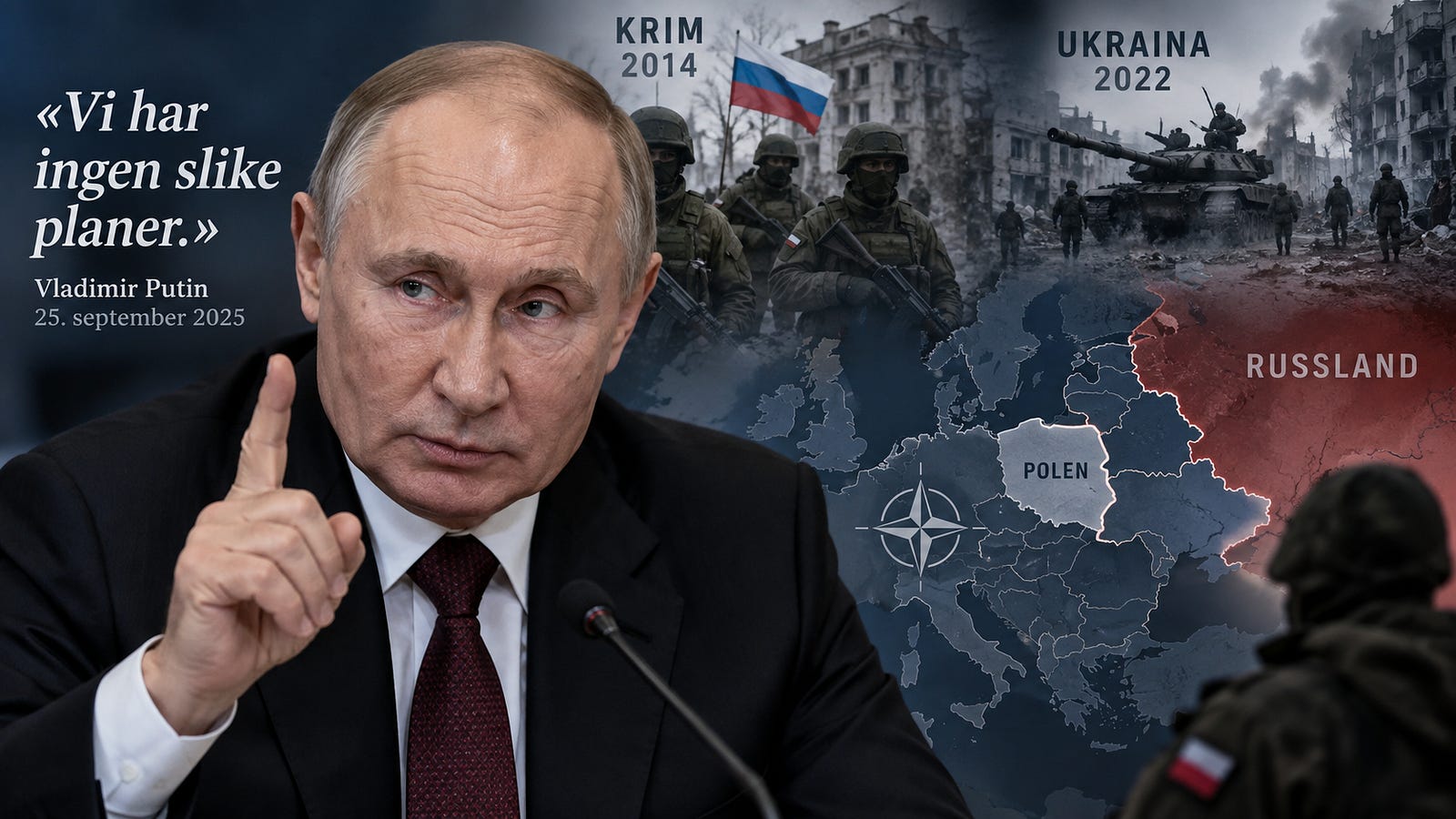
Polish Foreign Minister Radosław Sikorski issued the warning in New York on 24 September, during the UN high-level week. Poland is receiving information from several sources suggesting that Russia is preparing “something big” before the end of the year, he said.
Sikorski would not say where the information comes from or what Russia is specifically planning. He did, however, point to one possibility: a false flag operation — an action staged or carried out by Russia itself, but presented as an attack by someone else, such as Ukraine or NATO.
The purpose of such an operation could be to create a pretext for a new mobilisation inside Russia by making it appear that the country itself has been attacked.
Sikorski believes a direct Russian attack on a NATO country is unlikely because it would be extremely risky for Moscow. A more ambiguous operation, he suggested, may be more plausible — the kind of action that would make it harder for NATO to decide whether Article 5 should be invoked.
Putin responded the following day.
“We have no such plans”
In St Petersburg on 25 September, Putin denied that Russia is preparing military action against Europe.
“We have no such plans. And most importantly, there are no grounds for them,” he said.
At the same time, he described parts of Europe as aggressive and claimed that European governments are using Russia as a threat in order to justify continued support for Ukraine.
He also raised what he described as violations of the rights of Russian-speaking populations in the Baltic states, while saying that Russia would address the issue within the framework of international law.
The wording is familiar. Similar language has been used before — shortly before two of the biggest Russian military operations of the past two decades.
Nine days before the invasion
On 15 February 2022, Putin sat alongside Germany’s then chancellor, Olaf Scholz, in Moscow.
Russia had already massed large forces around Ukraine, while Western governments were warning that an attack could be imminent.
Putin was asked whether Russia wanted war.
“Do we want it or not? Of course not,” he replied, adding that Russia had therefore presented proposals for negotiations with the United States and NATO.
Nine days later, on 24 February, Russia launched its full-scale invasion of Ukraine.
The denial therefore came at a point when military preparations were already far advanced.
The uniforms could be bought in shops
An even clearer example came in Crimea in 2014.
Armed men without national insignia had seized key government buildings and Ukrainian military facilities. Many wore uniforms and carried equipment resembling that used by the Russian armed forces.
When Putin was asked on 4 March whether they were Russian soldiers, he replied that similar uniforms could be bought in shops and said the men were local self-defence forces.
Asked whether Russia had trained them, he said no.
Six weeks later, he gave a different version.
On 17 April, he said publicly:
“Of course, our servicemen stood behind Crimea’s self-defence forces.”
By then, Russia had already annexed the peninsula.
A pattern, not proof
This history does not prove that a new attack is imminent.
Sikorski has not yet presented the evidence behind his warning, and the phrase “something big” could cover far more than a conventional military operation — including sabotage or a hybrid attack.
But the pattern makes it difficult to treat Putin’s words as reassurance in themselves. Before Crimea, he denied a Russian military role that he later acknowledged. Before the invasion of Ukraine, he said Russia “of course” did not want war.
As long as Russia is waging war against a neighbouring country while also carrying out extensive hybrid operations against other neighbours — including drone incursions, sabotage and cyberattacks documented in several NATO countries — there is little reason to take Putin’s assurances at face value.
Historically, his words have been a poor guide to what Russia actually goes on to do.
Discussion about this post