Pepsi Stayed in Russia
PepsiCo has defended its continued presence by saying it supplies food and other essential goods to the Russian population.

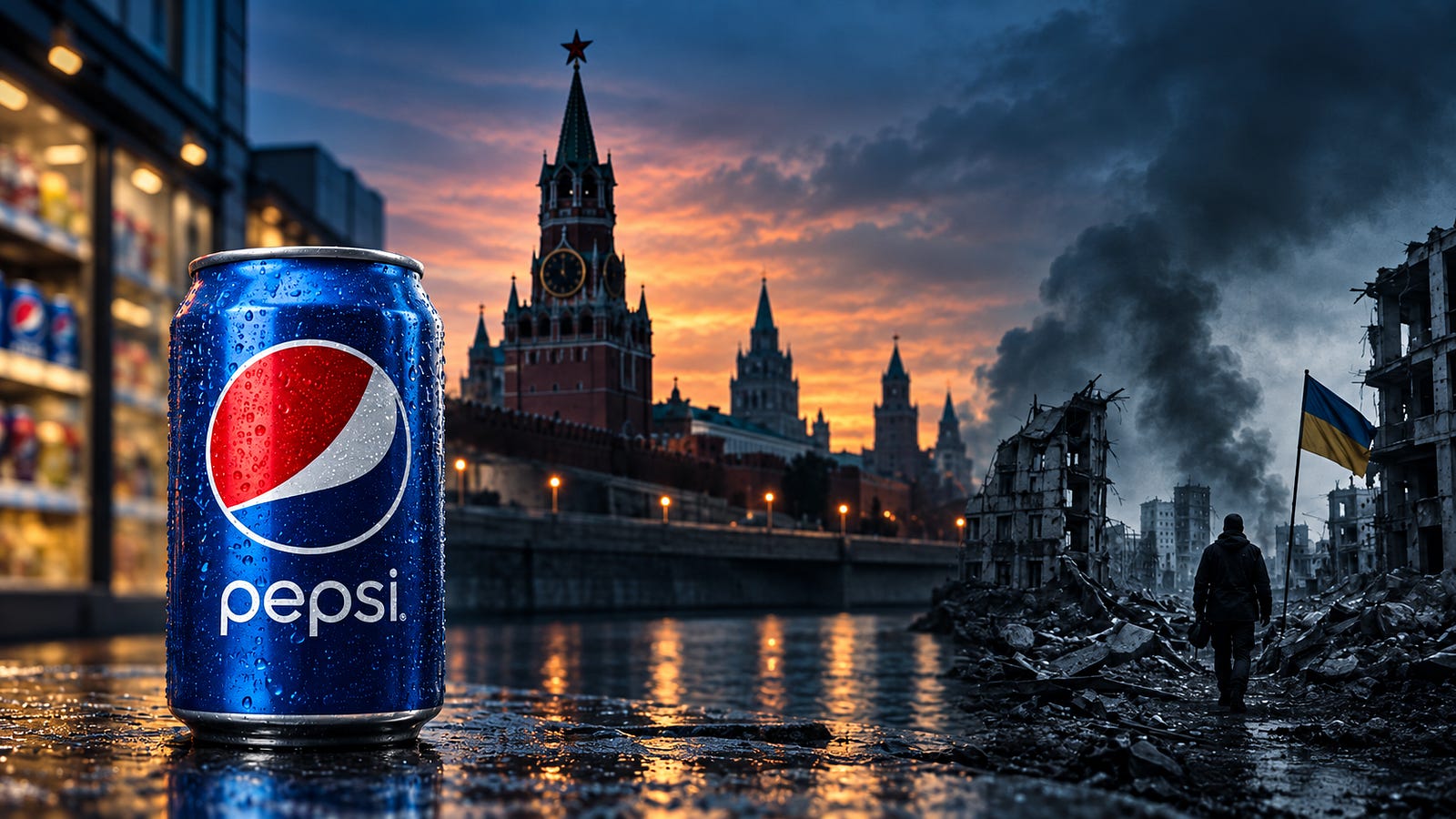
When Russia launched its full-scale invasion of Ukraine on February 24, 2022, a rare wave of unified corporate outrage swept through the West. McDonald’s shut its doors. IKEA packed up. Company after company left the market, with a message as simple as it was costly: a war of this kind was going to cost something.
PepsiCo chose a different path.
The company halted sales of its most famous brands — Pepsi-Cola, 7Up, Mirinda — and paused new advertising and investment. But beneath the surface, most of the business carried on as before. Snacks, dairy products, baby food and other beverages kept being made and sold.
That’s the distinction that matters: Pepsi disappeared from some store shelves. PepsiCo did not disappear from Russia.
Still a major market
The company’s own annual report gives a precise picture of just how large that presence remains. In 2025, Russia accounted for five percent of PepsiCo’s total net revenue — up from four percent the year before. For a single country within a global conglomerate, that’s a significant figure.
PepsiCo has defended its continued presence by saying it supplies food and other essential goods to the Russian population. That argument carries some weight when it comes to baby food and certain staple products. It grows thinner when the business also includes snacks and other items that are neither medicine nor necessities. If securing the food supply were really the point, the operation should look far narrower than it does today.
Pepsi is not alone
PepsiCo is hardly a special case. The Kyiv School of Economics tracks several thousand foreign companies through its LeaveRussia database, and as of July 2026, 2,362 of them were still registered as operating in Russia — 55 percent of all the companies the database monitors.
Among the major American and European names are Philip Morris International, Mars, Mondelēz, Procter & Gamble, Metro, Ferrero, Raiffeisen Bank International, UniCredit and OTP Bank.
They don’t all operate the same way, and shouldn’t be treated as if they do. Some have scaled back significantly. Others have tried to sell up but remain stuck in increasingly restrictive Russian regulations. But the economic ties persist, and the picture of a Russia cut off from Western business is far more nuanced than the rhetoric often suggests. American and European companies are still selling food, hygiene products, chocolate, tobacco and banking services in the country — and several of them are doing so very profitably.
The numbers underline the point. For the companies where KSE had financial data, combined revenue in Russia came to roughly $200.8 billion in 2025. Net profit was around $11.5 billion, and the companies paid about $5 billion in profit tax. That’s a substantial sum in a country simultaneously spending enormous amounts on war.
No one can point to a single bag of chips and say it financed a specific missile — a state budget doesn’t work that way. But corporate tax, payroll tax, duties and general economic activity all flow into the same state that is funding the war. That’s what makes this hard to explain away.
Sanctions with the shop doors open
Western sanctions on Russia are extensive, but they were never designed as a full economic blockade. Food, medicine, hygiene products and a range of ordinary consumer goods can still legally be sold, and there are good reasons for several of those exemptions — particularly when it comes to medicine and essential goods.
The problem arises when those same exemptions also become room for large international companies to keep turning a profit, year after year. That creates a paradox: Western governments spend billions weakening the Russian state, while companies from those same countries contribute tax revenue and economic activity inside Russia. It’s legally possible. It’s also worth discussing morally — a discussion I think has been far too muted.
Because this isn’t just about money flowing into a state budget. It’s about how the war is felt in Russian daily life. When store shelves are still full of familiar products — chocolate, pet food, detergent, snacks — the distance between the war and everyday life grows wider, and the economic isolation becomes less visible.
That’s precisely why the exits of companies like McDonald’s and IKEA carried such symbolic weight in 2022. Russians were meant to feel that their country had broken with something fundamental, and that it came with consequences beyond the battlefield. Four years on, that effect is far weaker than many might assume.
Russian authorities, meanwhile, have made it increasingly difficult to leave. In September 2026, the Russian operations of both Nestlé and Auchan were placed under temporary administration — a sign that companies which stay long enough can end up losing full control over their own exit.
PepsiCo made its fundamental choice long before that became an issue. The company could have withdrawn when the invasion began, absorbing the economic cost alongside those that did exactly that. Instead, the group held on to a substantial business in Russia — one that in 2025 accounted for five percent of PepsiCo’s entire net revenue.
It’s hard to read that as anything other than the market outweighing the morality.
Discussion about this post