Oleshky’s Evacuation Could Cement Russian Control
Civilians escaping Russian-occupied Oleshky face a danger beyond the battlefield: a temporary evacuation could become permanent displacement as Moscow tightens its control.

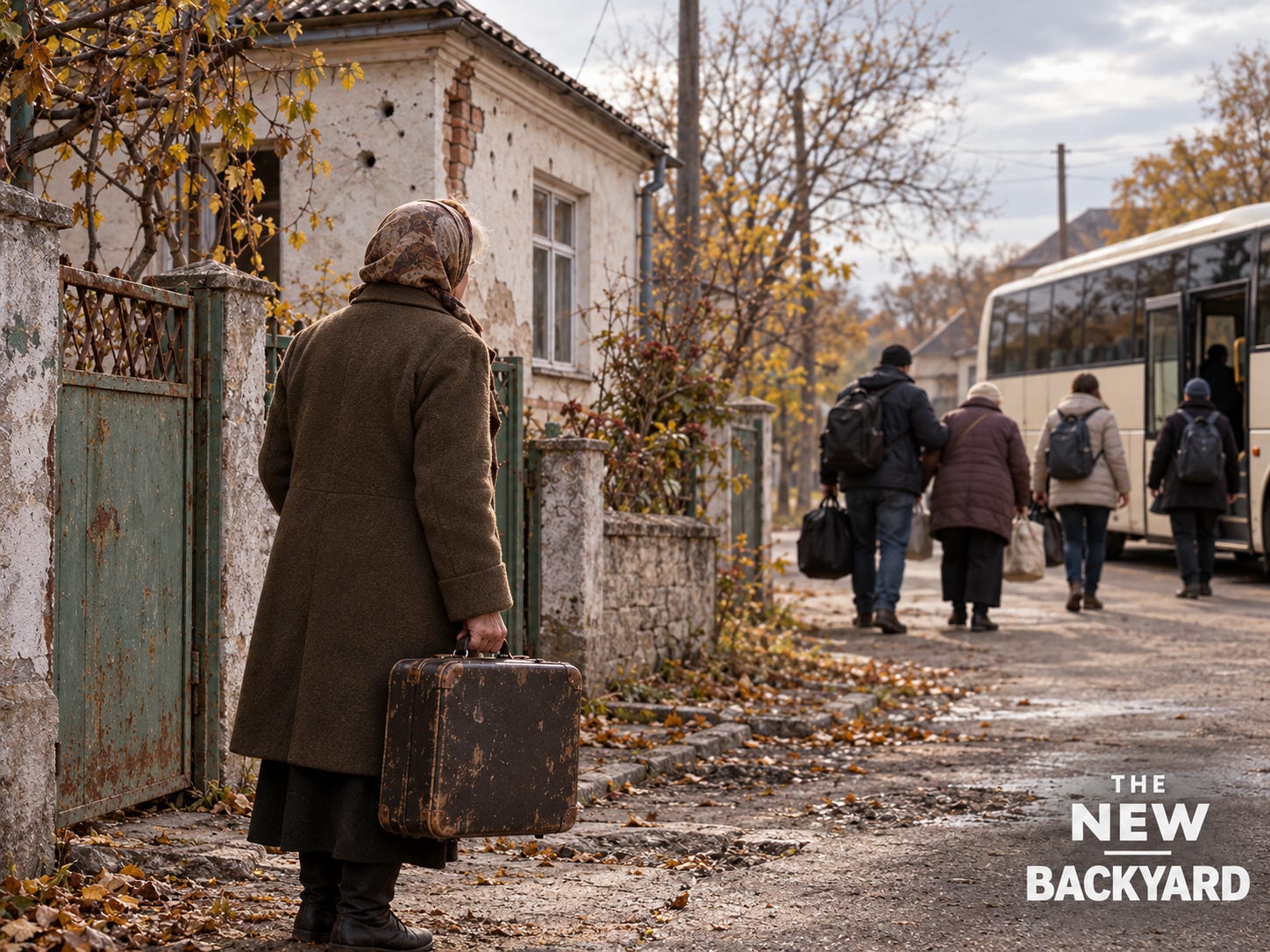
Residents evacuated from Oleshky, in southern Ukraine, reached Belarus on October 31 as Ukrainian authorities prepared to receive them. Ukrainian lawmaker Davyd Arakhamia said the fourth and final aircraft had landed in Gomel. He expected the evacuees and the Ukrainian delegation to reach Ukrainian-controlled territory within hours.
Their journey illustrates the power of the occupation. Ukrainian-controlled Kherson lies just across the Dnipro River. The agreed route instead took residents through Russian-occupied Crimea to Anapa, in southern Russia, before flying them to Belarus for the final journey into northern Ukraine.
The evacuation began on October 30 under a local ceasefire facilitated by US First Lady Melania Trump. Ukraine’s human rights commissioner, Dmytro Lubinets, coordinated the operation with Russia’s human rights commissioner, Yana Lantratova. The pause allowed food and medicine into the town and gave residents a route out.
The longer-term consequences will depend on what happens to the homes they leave behind.
A model for further evacuations
Published extracts from the agreement envisage a subsequent arrangement for regular aid deliveries and repatriation operations across settlements in the Kherson region, at least monthly. Interfax-Ukraine, citing the document, reported that this further cooperation would continue with Melania Trump’s assistance.
The operation also has a wider diplomatic purpose, according to Ukrainska Pravda. Citing anonymous sources involved in its organisation and within Ukrainian President Volodymyr Zelenskyy’s circle, the newspaper reported that Oleshky was being used to test whether military commanders could implement a political agreement to stop fighting. A successful operation could provide experience for further humanitarian corridors and a broader ceasefire.
Such cooperation offers different opportunities to the participants. Ukraine can bring citizens to safety. Washington gains a visible diplomatic result. Russia can benefit from images of cooperation while retaining control over occupied land.
Those interests can overlap during an evacuation and diverge over what follows.
Reports of soldiers entering homes
The military use of the town is already drawing scrutiny.
Ksenia Arkhipova, a volunteer who previously lived in Oleshky and remains in contact with residents, told The Associated Press on October 30 that Russian troops were checking empty houses and moving into some of them. She also alleged that soldiers were pressuring residents to choose evacuation to Russia.
These were reports from a volunteer’s contacts inside the town. They raise a concrete question about the relationship between civilian departures and military occupation of residential property.
Lubinets described an organised process offering residents a choice of destination. He said employees from both commissioners’ offices worked on every bus and that people wishing to remain in Oleshky received humanitarian assistance.
The distinction between an agreed choice and a person’s actual experience will matter throughout the journey.
How flight can become permanent
Elsewhere in occupied Ukraine, United Nations investigators have documented policies that turn departure into a lasting separation from home.
A report issued in 2026, covering July–December 2025, describes Russian pressure on residents to acquire citizenship through restrictions on healthcare and other essential services. It also records barriers to return, including entry refusals linked to perceived support for Ukraine.
In Donetsk and Luhansk, occupation authorities had registered at least 5,557 residential properties as “abandoned”. Russian legislation allows ownership to pass to the occupation authorities when owners fail to appear personally at court hearings. Displaced owners face dangerous journeys, restrictions on entry and Russian citizenship requirements for registering property.
These findings concern an established pattern across occupied territory. They explain why the fate of Oleshky’s evacuees must be followed beyond their arrival in safety.
A family may leave to survive the fighting, then encounter rules that prevent its return and transfer control of its home. Repeated across communities, that process can strengthen a lasting territorial division.
Kherson remains Ukrainian territory under international law. The UN General Assembly has reaffirmed Ukraine’s internationally recognised borders and condemned Russia’s attempted annexation of the region. The practical risk is that military control becomes increasingly embedded in property ownership and everyday administration.
Choices made under pressure
The humanitarian need is severe. In June, the UN Human Rights Monitoring Mission in Ukraine documented how drones and landmines obstructed food deliveries, medical assistance and evacuation around Oleshky.
The mission described Russian-controlled areas under attack from Ukrainian short-range drones, while responsibility for individual incidents remained to be established. Elderly residents and people with limited mobility faced particular difficulty reaching evacuation points. The same report stressed Russia’s obligation, as the occupying power, to ensure food and medical supplies and facilitate humanitarian relief.
For people living under those conditions, boarding a bus can be an urgent decision about survival. Their choice of route says little about their political allegiance or their wish to return.
Some residents have chosen to stay. Lubinets said people approached the delegation in Oleshky to explain that they wanted to remain in their homes, and that aid had been delivered to support them. The ceasefire is scheduled to expire on November 1. Their need for food, medicine and protection will continue after the convoy has gone.
Discussion about this post