Masked Anti-Immigration Protester in Vilnius Spoke Only Russian
A masked man at Saturday’s anti-immigration protest in Vilnius wanted foreign criminals deported. When LRT asked him for a comment, he answered in Russian. And only Russian.

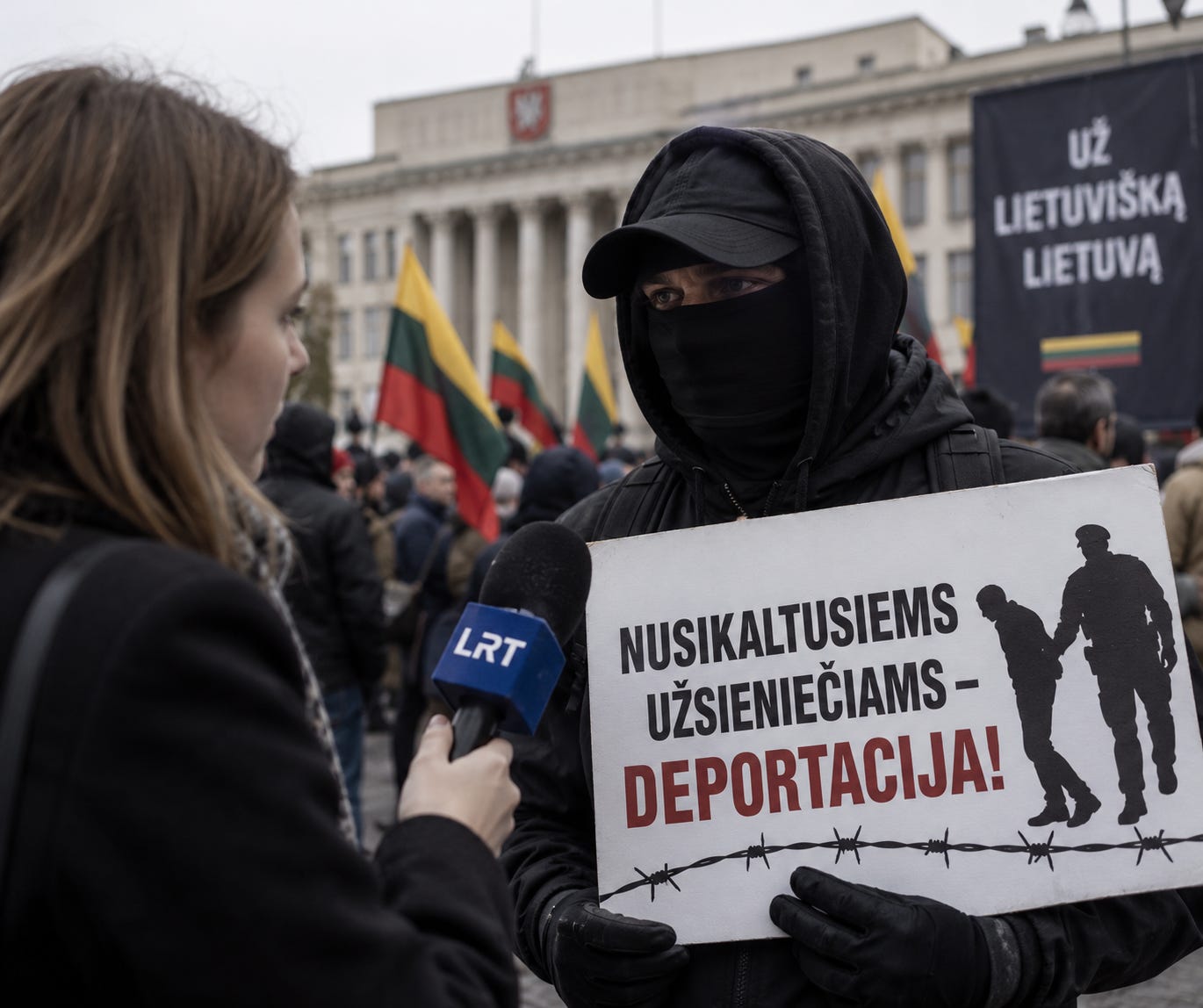
It happened in the middle of a rally promoting Lithuanian language and national identity.
On Saturday, October 3, several hundred people gathered in Vincas Kudirka Square in Vilnius, directly outside the government building. The protest was organized by the right-wing National Alliance, led by member of parliament Vytautas Sinica. Its demands included tougher deportation of foreigners convicted of crimes, lower quotas for migrant workers and the closure of centers recruiting foreign labor for Lithuania.
Then a journalist from public broadcaster LRT approached a masked man in the crowd.
“Deportation!”
The man was holding a sign that read “Nusikaltusiems užsieniečiams – deportacija”: deportation for foreign criminals.
The journalist spoke to him in Lithuanian. He replied in Russian that he only spoke Russian.
She tried again, asking whether he wanted migration stopped. The answer was the same: He did not understand Lithuanian. The journalist smiled, said something along the lines of “I understand, thank you,” and moved on.
The LRT video was later shared by the independent Belarusian outlet Nasha Niva.
The contrast is hard to miss. The organizers were promoting Lithuanian language and culture, while one of the participants could not say a word to the journalist in that same language.
The mask made the scene even more striking. Sinica had specifically asked people to remain peaceful and show up without masks or weapons. The demonstration was supposed to be a rally for a Lithuanian Lithuania.
Migration Has Become a Security Issue
Behind the strange scene in the square lies a much more serious conflict.
Lithuania shares a 679-kilometer border with Belarus, and since 2021 migration across that border has become part of the country’s security policy. Lithuanian authorities say the flow of migrants from Belarus is an organized operation.
The day before the protest, border guards discovered 35 people who had crossed through swampy terrain from Belarus. Helicopters, dog patrols and large numbers of border guards were deployed to find them.
Over the past five years, Lithuania’s border service has stopped more than 25,000 attempts to enter illegally from Belarus. Large stretches of the border are now protected by fencing and concertina wire.
For many Lithuanians, the debate is therefore about more than labor migration and integration. It is also tied to the country’s confrontation with Belarus and Russia. Foreign Minister Kęstutis Budrys has described the use of migrants as pressure, along with disinformation and other Belarusian provocations, as part of a broader hybrid campaign against NATO’s eastern flank.
Russian Is More Than Just a Language
That also gives the masked man’s use of Russian a particular significance.
In the Baltic states, Russian carries a different historical and political weight from other minority languages. The Soviet Union ruled Estonia, Latvia and Lithuania until 1991, and large Russian-speaking communities still live across the region.
The differences between the three countries are substantial. In Estonia, 29 percent of the population reported Russian as their native language in the 2021 census. In Latvia, 37.7 percent of people aged 18 to 69 said the same in a 2022 survey.
Lithuania has a much smaller Russian-speaking population. That makes the sight of a masked Russian-speaking man at a rally centered on Lithuanian language and identity stand out even more.
But it tells us nothing certain about who he is. The video shows the language he spoke, the mask, the sign and the fact that he was there. It does not show that he has any connection to Russia, or that he came to provoke anyone.
Three Protests, One Street
The entire episode unfolded in the middle of a broader political confrontation in central Vilnius.
More than 300 people attended the National Alliance rally in Vincas Kudirka Square. Across Gedimino Avenue, more than 100 counterprotesters gathered for an anti-racism demonstration. A third rally, under the slogan “Wake Up From Hate,” took place in Lukiškės Square.
Police deployed around 240 additional officers. Police Commissioner General Arūnas Paulauskas said beforehand that authorities had identified certain individuals who could pose an increased risk and were preparing for several possible scenarios.
In the middle of it all stood the man with the deportation sign. A small moment in a much larger struggle over migration, language, identity and security in the Baltic states.
The journalist asked him one simple question in the country’s own language.
The answer came in Russian.
Discussion about this post