In Norway, leaders lay out peace proposals and face questions over US support
At a press conference in Oslo on Tuesday evening, Ukrainian and Nordic leaders outlined security proposals and answered questions about American support and Russia.

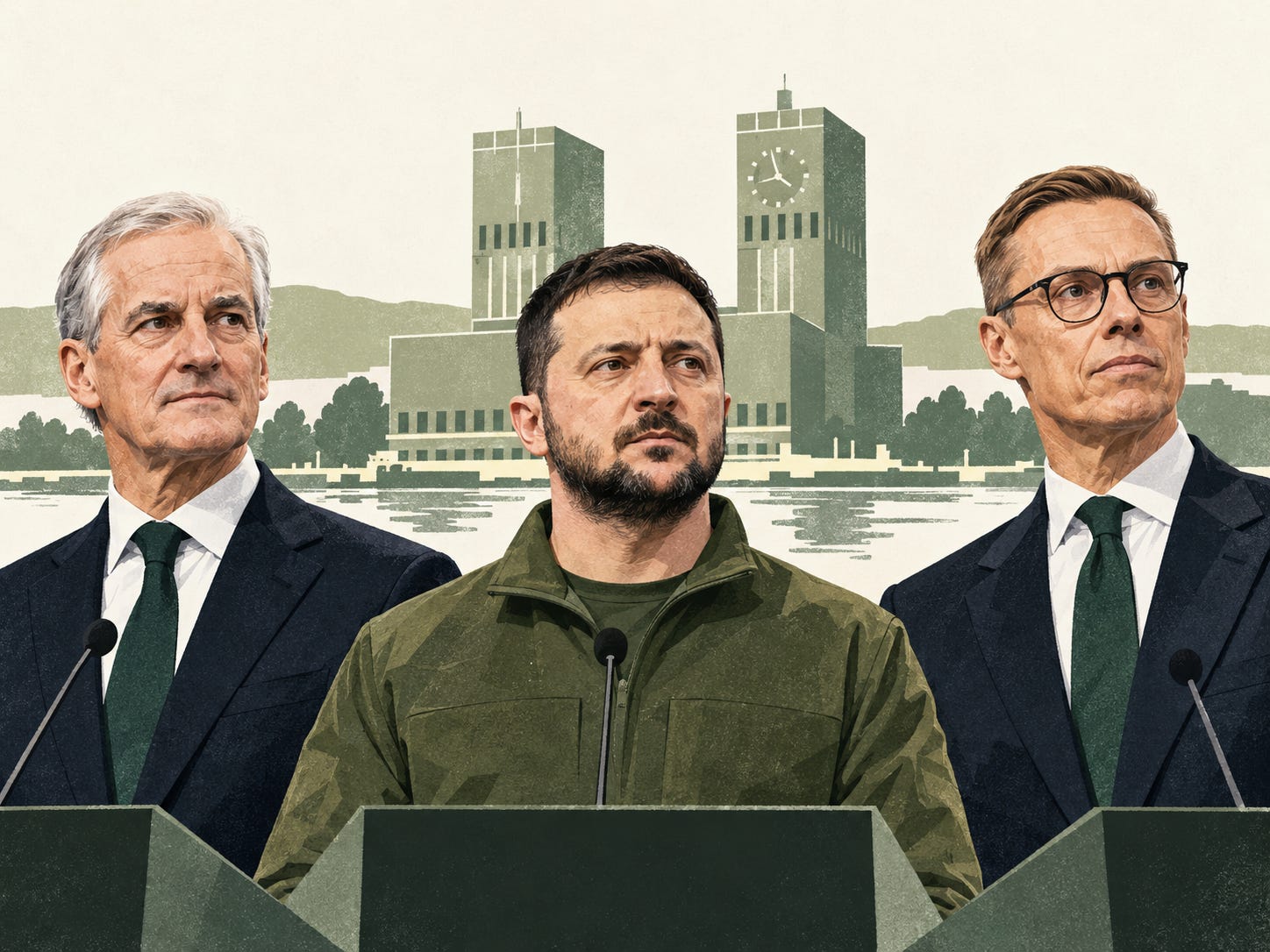
Ukrainian President Volodymyr Zelenskyy, Norwegian Prime Minister Jonas Gahr Støre and Finnish President Alexander Stubb presented the results of talks in Norway on October 20, ahead of US envoy Steve Witkoff’s planned visit to Russia the following day.
The discussions covered security guarantees for Ukraine, reconstruction, territorial questions, sanctions and possible partial ceasefires. They also addressed the immediate needs of a country facing continued Russian attacks: air defense, intelligence and reliable communications.
Witkoff, representing US President Donald Trump, participated in the Oslo meeting. Jared Kushner, who is also involved in the American diplomatic effort, joined by video.
Støre said the American envoy would take proposals developed with Ukrainian and European partners to St. Petersburg, where he would meet Russian leaders and explore the possibility of a meeting at the level of heads of state.
Security guarantees reach a written document
Zelenskyy said several possible security arrangements had been included in a document that Witkoff would share with Russia.
He mentioned NATO, the North Atlantic Treaty Organization, its Article 5 collective defense provision, and an alternative he called “Article 5 Lite.” The meaning of that final option, including the obligations it might place on Ukraine’s partners, remained undefined at the press conference.
The Ukrainian president said the American side had again emphasized that the guarantees should be strong. He expected feedback after Witkoff’s discussions in Russia.
Stubb described progress on two levels. The broader negotiations concerned the foundations of peace, including security and economic arrangements. The immediate discussions addressed air defense, energy installations and partial ceasefires covering energy and food security.
He said the proposals built on earlier talks involving American, Ukrainian and European representatives in Miami.
Questions about Trump lead to missiles and intelligence
Asked about his confidence in the United States and Trump, Zelenskyy pointed to a conversation earlier that day with US Secretary of State Marco Rubio.
They had discussed Starlink, the satellite communications system used by Ukraine, interceptor missiles and intelligence cooperation. Zelenskyy described the exchange as practical and positive, adding that another conversation could follow within 48 hours.
A Ukrainian television journalist pressed him on whether Rubio or the American envoy had provided guarantees that questions involving missiles, intelligence and Starlink would be resolved within days.
Zelenskyy gave a specific answer about early warning of ballistic missile attacks. American intelligence supporting that warning was functioning, he said, emphasizing its importance for children and other civilians seeking shelter.
“Now it works,” he said.
His answer concerned that warning capability. Discussions about Patriot air defense and Starlink were continuing, and he expressed confidence that further contact with Rubio would produce a positive result. Details of firm commitments on those issues remained pending.
An offer to halt attacks on energy facilities
Zelenskyy said Ukraine had immediately supported an American proposal for an energy ceasefire, while Russia had continued its attacks.
He described a reciprocal offer: Ukraine would suspend strikes on sensitive parts of Russia’s energy sector if Russia stopped striking Ukrainian energy installations.
Russian President Vladimir Putin had rejected the offer, Zelenskyy said. Efforts to find a workable arrangement were continuing.
Stubb also identified energy and food security as areas where partial ceasefires could provide more immediate progress while negotiations over a broader settlement continued.
For Ukraine, Zelenskyy said, demonstrating de-escalation was important. He placed the ceasefire proposals alongside the larger questions of security guarantees and rebuilding the country after the war.
A question about defeat brings an answer about human losses
A Norwegian news agency journalist asked what message Zelenskyy had given Witkoff to take to Putin, then challenged him about whether Ukraine was losing the war.
Zelenskyy defended Ukraine’s position and focused on the lives being consumed by the fighting. Russia’s attacks were costing Ukraine people and time, he said, while children were growing up deprived of an ordinary childhood.
He called for the war to end as quickly as possible and appealed to American and European partners to help achieve that.
The Ukrainian president also paid tribute to the soldiers holding the battlefield. Their strength, he said, helped him remain strong during negotiations.
On territory, he said the most sensitive questions required discussion at the highest political level. The negotiations also had to address what would follow the fighting, including reconstruction and the conditions under which Ukrainians would live.
Ukraine demands its place in decisions about its future
Asked about a possible summit involving Trump, Putin and Chinese President Xi Jinping, Zelenskyy clarified which three leaders he wanted to bring together: those of Ukraine, Russia and the United States.
He said Ukraine’s participation was a condition for any acceptable negotiations about its future.
Støre had established the same principle in his opening remarks, affirming Ukraine’s right to participate in decisions concerning the country and to pursue a just and durable peace.
A New York Times journalist asked whether the Oslo meeting had changed Zelenskyy’s earlier concern that Washington was pressing Ukraine toward capitulation.
Zelenskyy highlighted the positive signals from his conversation with Rubio and the constructive dialogue in Oslo. He pointed toward the following day’s discussions in Russia as the next test of the process.
Støre calls for Europe to shape its own security
Støre argued that Europe needed a stronger place in negotiations that would shape the continent’s security order.
He acknowledged that Europe had played too small a role and called for greater European unity at the negotiating table.
“Europe will live with the consequences,” he said.
Asked whether Europe could negotiate with Russia independently of the United States, Støre argued that a lasting settlement required the involvement of the United States, Ukraine, Russia and Europe, as well as other important countries affected by the war.
He also explained Norway’s role in arranging the meeting. Zelenskyy had asked Norway to host, and Støre and Stubb were participating as leaders of two countries that share borders with Russia.
Their experience of that relationship, he said, informed their search for stability and peace.
Reporters press the leaders on Washington’s direction
Questions from the press repeatedly returned to whether the United States was shifting toward Moscow.
Støre focused his answer on the work ahead. He said the Oslo discussions had helped clarify issues and praised Witkoff for spending the day with Zelenskyy’s team.
He also highlighted his longstanding relationship with Stubb. Both had worked on relations with Russia as foreign ministers, bringing experience from earlier phases of European diplomacy.
Stubb gave a more direct assessment of American intentions. He said the Trump administration’s top priority was finding a peaceful solution to Russia’s war of aggression against Ukraine.
He described substantive technical progress beneath the public controversy and said the process felt back on track. The messages Witkoff brought back from Russia would help determine what followed.
Asked why the American envoy had stayed away from the press conference, Støre explained that the event brought together the political leaders.
Russia’s relationship with Iran enters the discussion
A Norwegian broadcaster asked whether Putin was using Russian support for Iran to gain influence over Trump.
Zelenskyy said Russia was supporting Iran and referred to drone components as part of what Ukraine had observed. He also said he believed Moscow had shared satellite intelligence and other information, while acknowledging the limits of his knowledge.
Stubb connected that discussion to Ukraine’s assistance to Gulf states and American partners confronting Iranian missile and drone attacks.
Ukraine’s experience of modern warfare, he said, had given it knowledge that was relevant to the security of those countries.
European talks continue into the evening
Støre said the Oslo discussions would continue over dinner with security advisers representing the European Union, NATO, Britain, Germany and Italy.
Stubb described the Norwegian and Finnish role as helping sustain dialogue, build confidence and support Ukraine, guided by international law and their own countries’ security interests.
He said American engagement remained essential and characterized the Oslo meeting as a step in the right direction.
“Peace requires patience,” Stubb said. “But unfortunately, war does not wait. People are dying every and each day.”
Discussion about this post