How My Substack Comes Together
Many people ask how my Substack comes together. The short answer is that it has grown gradually, through travel, journalism, photography and, increasingly, the extensive use of AI-agents.

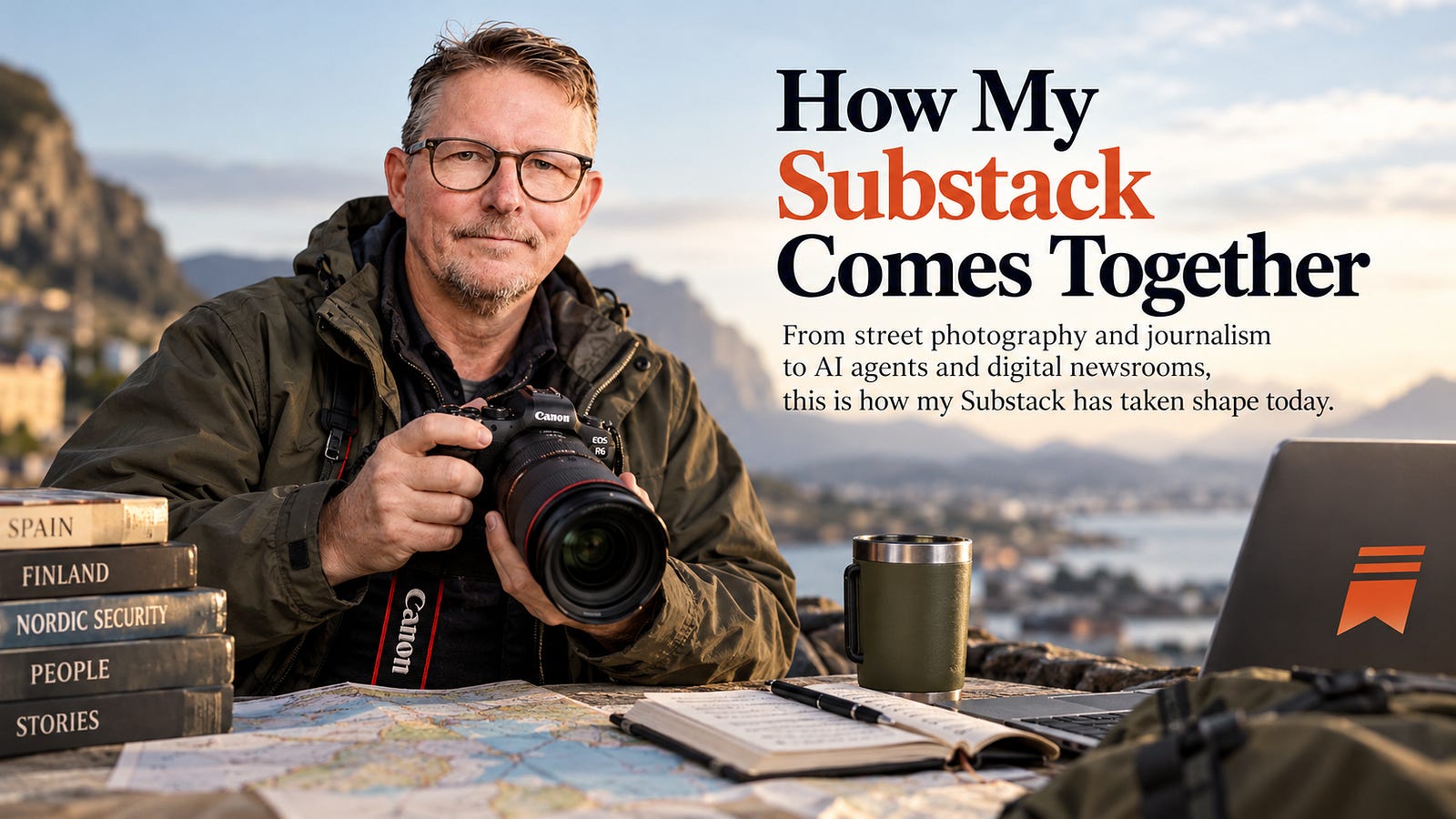
What began primarily as a place to publish my own photographs and articles has developed into something resembling a small digital newsroom.
The starting point, however, was fairly traditional. I travelled through Spain by train, working with street photography and writing articles about events and stories I encountered along the way. Later, the journey continued to Finland, where I travelled along the border with Russia and developed the project NATO’s New Backyard. That was also when the idea of bringing more of my work together in one place began to take shape.
The stories needed a home
I have written articles and taken photographs for local media in Norway. At the same time, I have regularly come across people, events and stories that I find interesting, but which are not necessarily given priority by established media. Sometimes they are small local events; at other times they are larger subjects that require more time and space than an ordinary news story allows.
Over time, I found myself with more and more material that had no natural place to live. I already had a website on Squarespace, but it worked better as a presentation site than as a living publication. I wanted something that could evolve from day to day, more like a magazine or a small online newspaper.
That is when I discovered Substack. The platform gave me a way to bring photography, reporting, commentary, analysis and larger projects together in one place. I have also gained readers from many parts of the world, and Substack’s translation tools allow me to write in the language that suits an article without having to produce separate versions for every audience.
A digital news desk began to take shape
As I started publishing more, another problem emerged: there is far more interesting material out there than I could ever discover and follow up on by myself. This is where artificial intelligence gradually became a larger part of my workflow.
I have developed several AI agents that monitor hundreds of sources within subjects I have defined in advance. They look for new developments, official documents, statements, reports and other leads that may be relevant to the topics I cover. The agents do not decide what becomes a story. I see them more as an extensive source network that is constantly looking for material.
Their findings arrive at what I have come to think of as my digital news desk. This is where I go through the material, decide what is interesting, examine the sources and choose which stories I want to pursue. Only then does the article itself begin to take shape.
Sometimes AI produces a useful first draft. At other times, I end up rewriting almost everything. Much of the work is therefore about deciding what to leave out as much as what to include. I spend a great deal of time on structure, priorities, language, grammar, tone, angle and coherence, because a large amount of information does not automatically make a good article.
I use several AI models
I do not use a single AI model for every task. Over time, it has become clear that different models have different strengths, so I use them much like different tools within the same newsroom.
ChatGPT Sol and Astra handle much of the initial work and are used in several of the agents I have developed. This is also where much of the work on the visual side and the comic strip has been developed. Over time, I have built fairly detailed workflows and preferences that help bring the results closer to the style I want.
I use Grok differently. It is often good at finding sources that ChatGPT does not pick up, particularly on X and other social media platforms. That can be important in stories where statements, images or discussions first appear on social media before they eventually reach conventional news outlets.
When an article has begun to find its shape, I also use Claude as a sparring partner. It can be useful when I want a fresh look at the text and need to work further on rhythm, tone, structure and flow. Having another model read a piece I have been staring at for a long time can be surprisingly helpful.
I also test other models and services as they appear. Not because I need as many tools as possible, but because I am curious about what they are actually good at. Leonardo is one example of a service I have experimented with for photography and illustration. For me, the question is therefore less about finding one “best” AI and more about finding the tool that works best for the particular job I am doing.
Images are part of the process too
Photography remains an important part of what I produce. When I have actually been somewhere myself, I prefer to use my own photographs because they form part of both the documentation and the experience of the place. My journey through Spain and my work along the Russian border in Finland would have been very different without the photographs.
At the same time, there are many stories for which I do not have a relevant image. In those cases, I use AI-generated illustrations. This too has developed from fairly random experiments into a much more established workflow. I have created my own preferences for composition, light, colour, level of detail and overall visual expression so that the images fit with the rest of the publication.
Sometimes I use my photographs on their own. At other times, I develop photographic ideas further with AI. What matters to me is that the image adds something to the story rather than simply decorating the text.
The comic strip makes room for something different
Much of what I write about involves politics, war, security, economics and other subjects that can quickly become heavy. I therefore wanted to create something that would also make room for humour and satire.
That is how the comic strip began. It may look like a small side project, but I have spent a great deal of time developing the characters, their personalities and the way they interact with one another. They now have established roles, attitudes and ways of reacting, which means I can use them to comment on current events without having to start from scratch every time.
I write most of the dialogue myself. AI can suggest ideas, but humour remains an area where I often find that the models explain the joke instead of delivering it. A line can be grammatically perfect and still be completely unfunny. Much of the work on the comic is therefore still done the old-fashioned way: trying, deleting, rewriting and searching for the line that actually lands.
I welcome your input
I really appreciate comments and feedback. This project is as much a process of development and learning — exploring how I can use different AI models — as it is a finished publication or blog. The direction becomes clearer as I work with the material, and the creative learning process is one of the main things driving me forward.
I hope you will subscribe and share the publication. I also welcome tips about stories and subjects that fit within the areas I cover.
And I want to publish more about culture in the months ahead.
I promise.
Discussion about this post