Drone War Reaches Deep Into Russia as Attacks Kill Civilians on Both Sides
Ukrainian drones struck Russian industry while attacks killed civilians across the border and Russia launched fast-moving drones against Ukrainian communities.

The New Backyard | October 25, 2026
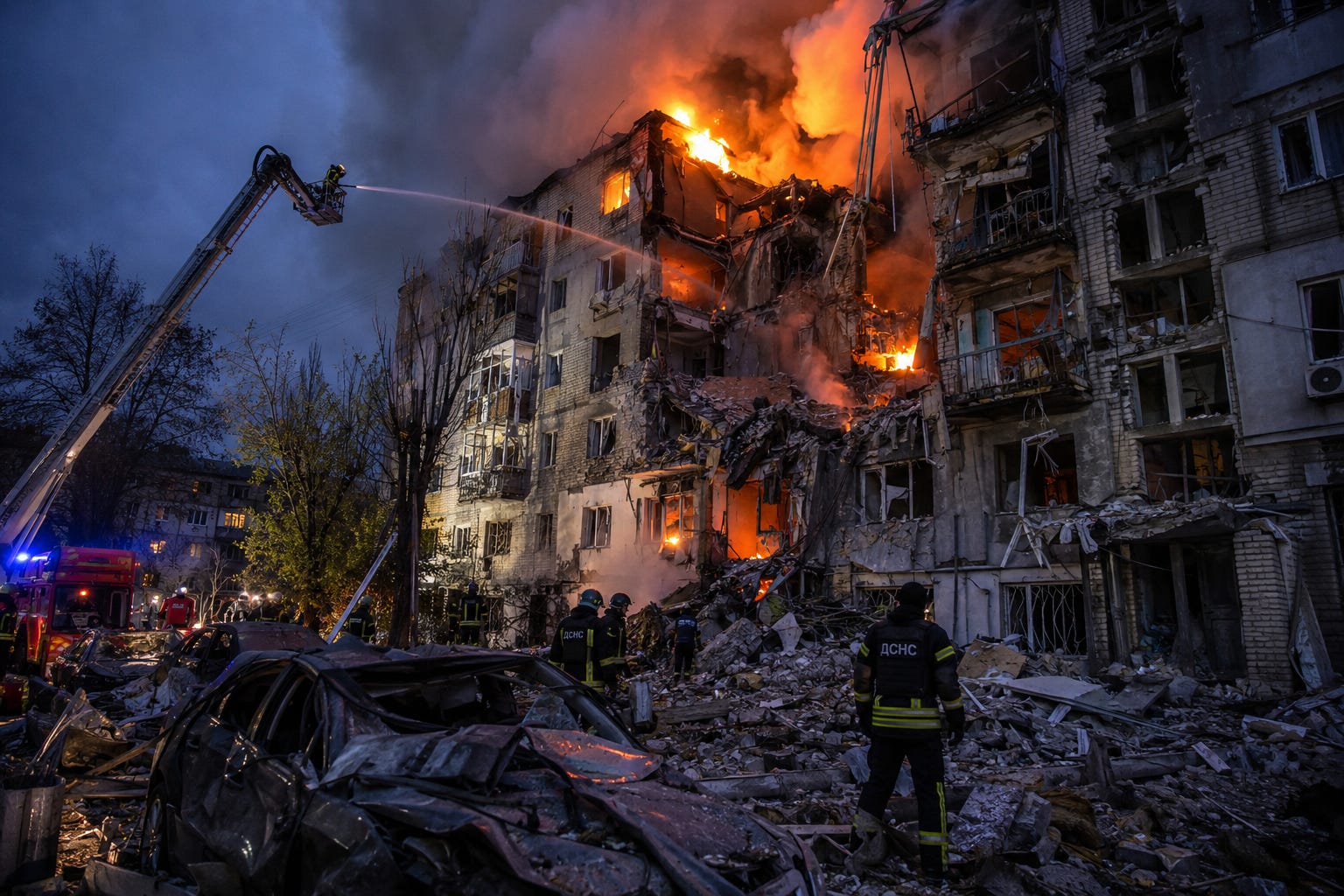
Russia’s war against Ukraine continued to spread across industrial and civilian infrastructure over the weekend, with Ukrainian strikes damaging Russian factories as Moscow launched another wave of long-range drones against Ukrainian cities.
On Sunday, five workers were injured when a drone attack damaged an industrial facility in Russia’s Perm region, deep inside the country. Regional Governor Dmitry Makhonin confirmed the incident and said emergency services had been deployed.
Meanwhile, Russian authorities reported three civilians killed and 14 injured in attacks across the Belgorod region, near the Ukrainian border. The overnight strike on Belgorod city killed two men and injured 13 people. Another person was killed near Shebekino.
Governor Alexander Shuvayev reported damage to 30 apartment buildings, 35 vehicles, four private houses, three administrative buildings, eight commercial premises and three social facilities.
Ukraine Targets Russia’s Military Supply Chains
The weekend attacks followed Ukrainian strikes on Russian industrial installations linked by Kyiv to the production of military equipment and weapons.
In Tolyatti, in Russia’s Samara region, local authorities confirmed damage to several industrial facilities following a drone attack on October 24.
Ukraine’s General Staff identified the Tolyattikauchuk petrochemical plant as one of the targets. The factory produces synthetic rubber and other chemicals that Ukrainian military officials say contribute to the production of solid rocket propellant.
The strikes also reached Oryol, where Ukraine reported hitting the main production building of Proton-Elektrotex, an electronics manufacturer.
According to Ukraine’s General Staff, the company produces components used in Russia’s Iskander ballistic missiles, cruise missiles and Pantsir air-defense systems.
Oryol Governor Andrei Klychkov confirmed that three people had been killed in a missile strike on an industrial enterprise on Friday, October 23. Russian authorities described the facility as civilian.
Ukraine also reported striking an aircraft at the military airfield in Yeysk, on Russia’s southern coast.
The Ukrainian military subsequently announced further operations against Russian radar installations in the Belgorod region, command posts in occupied Zaporizhzhia and Kherson, and troop concentrations in occupied Ukrainian territory.
These operations reflect Kyiv’s continuing effort to disrupt Russian military production, surveillance and command structures rather than limiting its defenses to the front line.
Moscow Reports 532 Drones Intercepted
Russia’s Defense Ministry claimed Sunday that its air defenses had intercepted and destroyed 532 Ukrainian dronesbetween 8 p.m. Saturday and 8 a.m. Sunday, Moscow time.
The ministry reported interceptions across 24 Russian regions and Russian-occupied Crimea, as well as over the Sea of Azov.
The reported activity stretched from the border regions of Belgorod, Bryansk and Kursk to industrial regions farther east, including Perm, Tatarstan and Udmurtia.
The figures represent Russia’s official military account of its air-defense operations.
For Russian communities, the consequences were visible in damaged homes, disrupted transport, industrial emergencies and civilian casualties.
Russia Sends 153 Drones Against Ukraine
While Ukrainian drones crossed Russian territory, Moscow continued its own long-range campaign against Ukraine.
Ukraine’s Air Force reported that Russia launched 153 attack drones overnight into October 25, including 92 jet-powered drones.
The attack included Shahed-type weapons, S8000 Banderol/Dan-T drones and other unmanned aircraft launched from Russian territory and occupied areas of Ukraine.
Ukrainian air defenses reported intercepting or electronically suppressing 119 drones by 8 a.m. local time. The military recorded strikes at 15 locations.
The increasing use of jet-powered weapons is especially significant. Their higher speeds reduce the time available for Ukrainian air-defense teams to detect, track and intercept incoming attacks.
Four Killed in Attack on Ukrainian Apartment Building
In Synelnykove, in Ukraine’s Dnipropetrovsk region, a Russian drone struck a residential apartment building on Saturday evening.
The attack killed four people and injured 13, including an 11-year-old girl. A 62-year-old man died in hospital Sunday morning, bringing the death toll to four.
The strike ignited fires in the five-story building, nearby shops and parked vehicles. Four injured residents remained hospitalized in serious condition.
In Kharkiv, a Russian jet-powered drone struck the Novobavarskyi district late Saturday, killing one person and injuring four others.
Another Russian drone attack hit a cattle farm in Ukraine’s northeastern Sumy region, killing a 31-year-old female worker and injuring four people. Emergency crews recovered her body from the rubble. Farm animals were also killed and injured.
These attacks illustrate the human consequences of Russia’s continuing aerial campaign. Homes, workplaces and agricultural facilities remain exposed to long-range weapons, while emergency services operate under the constant threat of further strikes.
Russia’s War Industry and Ukraine’s Civilian Life
The two countries’ drone campaigns reflect different strategic circumstances.
Ukraine is attempting to weaken the industrial and military infrastructure supporting Russia’s invasion. Russia continues to attack Ukraine’s cities, infrastructure and military positions while occupying internationally recognized Ukrainian territory.
The distinction matters under international humanitarian law. Military objectives may be attacked subject to the rules of distinction, proportionality and precautions, while civilians and civilian objects remain protected regardless of which country they are in.
The latest strikes have brought those consequences into sharp focus. Russian industrial workers and residents of Belgorod have suffered casualties, while Ukrainian families continue to lose relatives in their homes and workplaces.
As the war approaches another winter, long-range drones have extended its reach far beyond the battlefield, drawing factories, electricity networks and residential communities into the daily reality of Russia’s invasion.
Discussion about this post