Cuba Is Once Again Caught Between the United States and Russia
The United States is increasing pressure on Cuba, while Russia and China are backing Havana. During UN week, an old great-power rivalry became visible again.

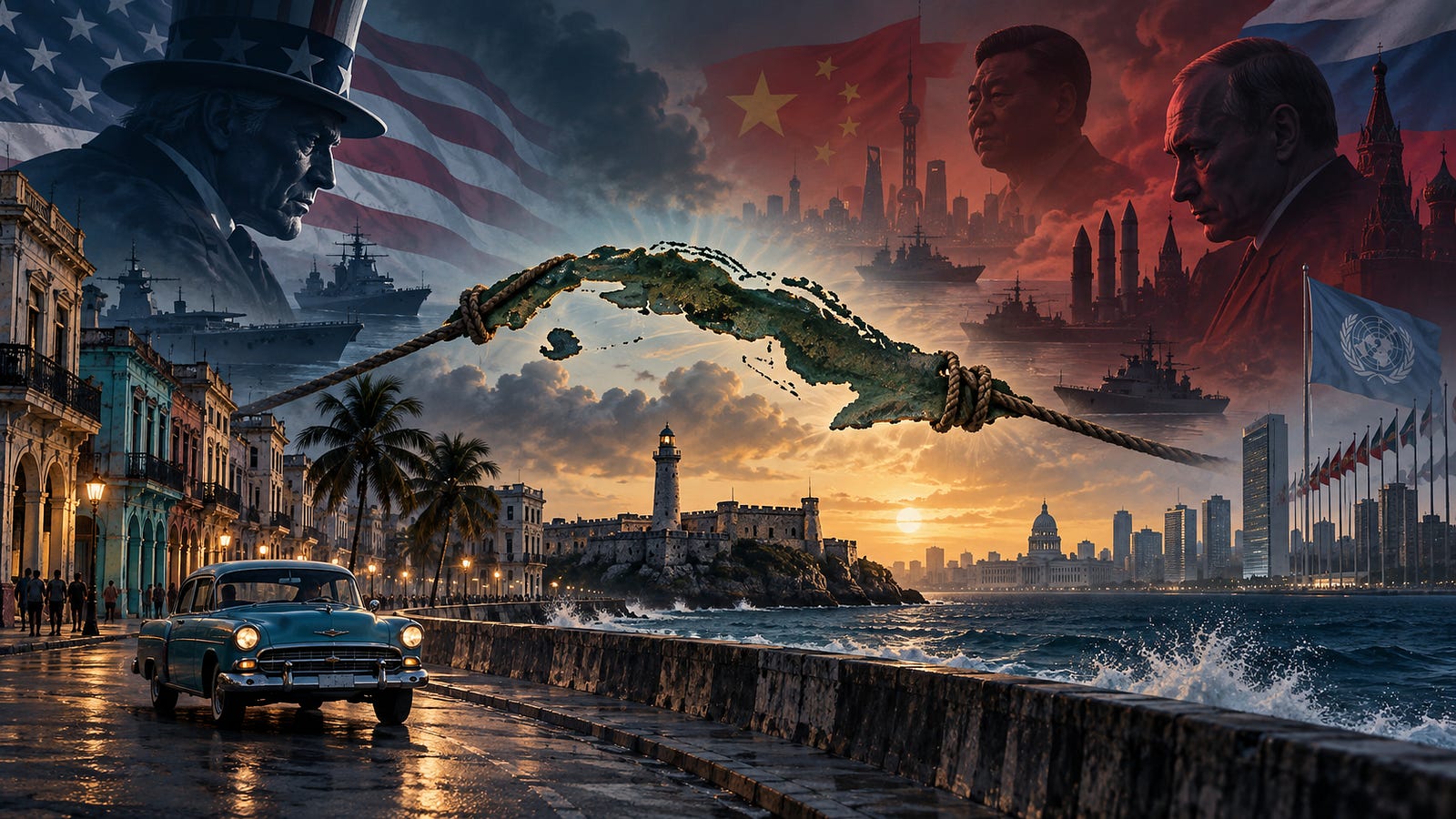
When Donald Trump took the podium at the UN General Assembly in New York on September 22, he delivered an unusually direct message to Cuba. He described the country as a failed state, said the communist government was under unprecedented pressure, and declared that freedom would soon come to the island.
The Cuban delegation responded by walking out of the chamber.
That might have been just another verbal confrontation between Washington and Havana. But what happened over the following days made the story much bigger.
Russia backs Cuba
The next day, Cuban Foreign Minister Bruno Rodríguez Parrilla met Russian Foreign Minister Sergey Lavrov in New York.
They discussed bilateral relations and international affairs, while Cuba described its relationship with Russia as strategic and extensive.
The timing mattered.
As the United States increased pressure on Cuba from the UN podium, Moscow made it clear that Havana still has the support of a major power.
For Russia, Cuba matters for reasons that go far beyond trade and diplomacy. The island lies only around 150 kilometres from Florida, placing it directly inside what Washington has traditionally regarded as its strategic neighbourhood.
There is also an obvious parallel with Russia’s own arguments.
The Kremlin has spent years objecting to Western political and military influence close to Russia’s borders. At the same time, Moscow maintains a close relationship with Cuba just off the coast of the United States.
China enters the picture
Russia was not alone.
When China addressed the UN on September 26, Beijing called on the United States to stop threatening Cuba and to lift its economic restrictions on the country.
What began with Trump’s attack on the Cuban government therefore quickly became part of a wider confrontation between the major powers.
On one side is the United States, which wants political and economic change in Cuba.
On the other are Russia and China, both of which invoke Cuban sovereignty in opposing American pressure.
That does not mean Moscow or Beijing necessarily put the interests of the Cuban people first. Both have strategic interests of their own.
Then Trump changed his tone
Four days after his UN speech, there was another shift.
On September 26, Trump said he believed the United States and Cuba would reach a deal, and that he did not expect American military force to be necessary.
In just a few days, the signals from Washington had moved from predictions of the Cuban government’s collapse to talk of negotiations and a possible agreement.
What such an agreement might contain remains unclear.
What is clear is that Cuba is in an extremely vulnerable position. The country is under severe economic pressure, while the United States, Russia and China are once again making the island part of a much larger geopolitical struggle.
Cubans should decide Cuba’s future
In the worst case, this could develop into a new Cuban crisis — not necessarily one involving nuclear missiles, as in 1962, but another great-power confrontation centred on a small island in an exceptionally strategic location.
In the best case, the current pressure could help open a path towards greater freedom and democracy for the Cuban people.
But there is little reason to romanticise any of the major powers involved.
Neither Donald Trump’s United States, Vladimir Putin’s Russia nor Xi Jinping’s China can be regarded as uncomplicated guarantors of democracy in Cuba. All three have interests of their own to protect.
And all of this is happening at a time when the United Nations appears increasingly weak whenever major powers decide to act on their own terms.
So the hope must be that Cuba is not once again reduced to a piece on someone else’s geopolitical chessboard.
And that, in the end, it is the Cuban people themselves who get to decide Cuba’s future.
Discussion about this post