Benjamin Netanyahu: The Making of Bibi
Who is Benjamin Netanyahu? From childhood and family to religion, Israeli politics, Gaza and power, this is the story of the man who became Bibi.

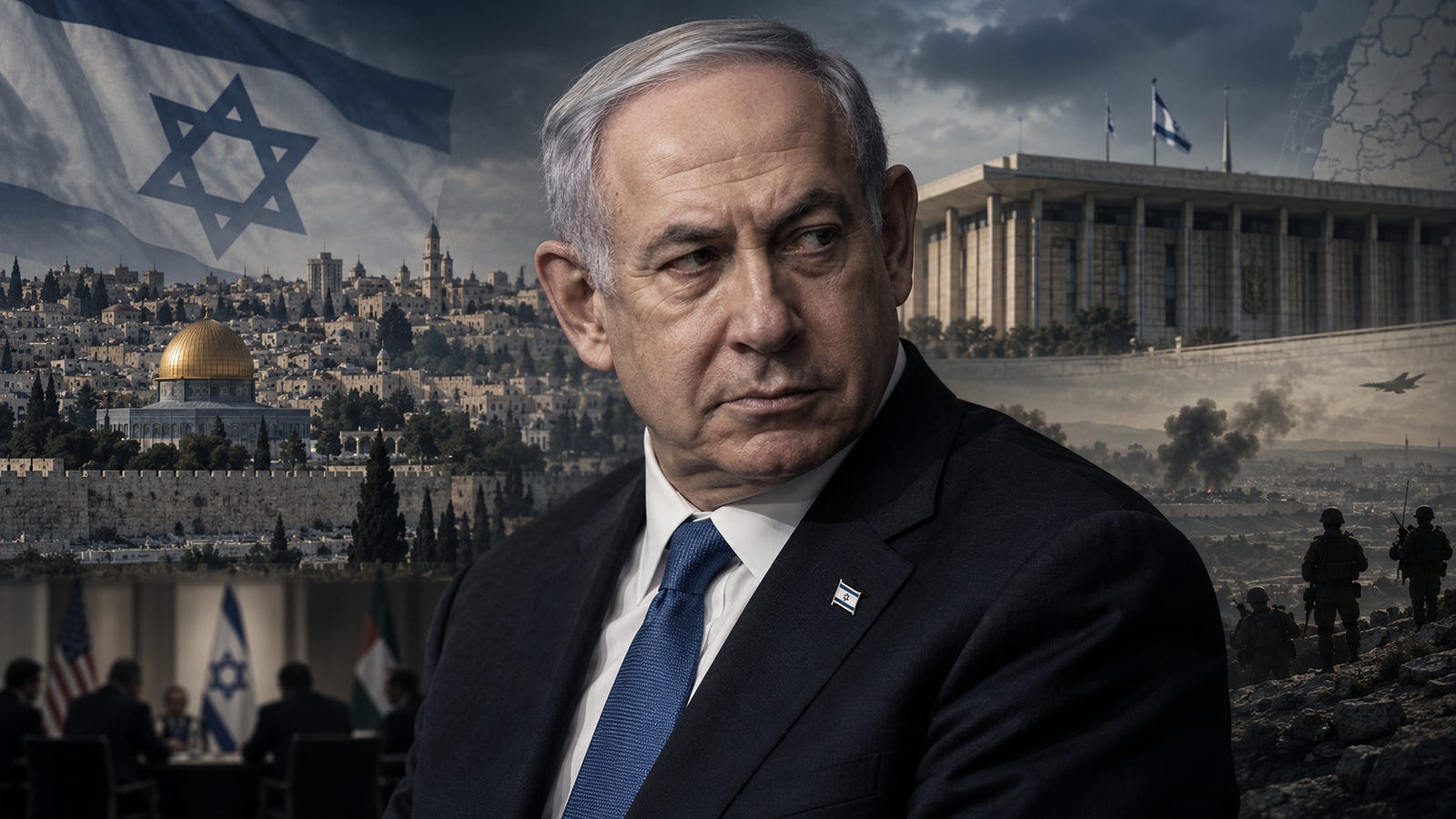
Before the motorcades, the war rooms and the speeches at the United Nations, before Gaza, Iran, the corruption trial and the arrest warrant from the International Criminal Court, there was a boy moving between two worlds.
One was Jerusalem — a young state surrounded by enemies, still living close to the memory of the Holocaust and the wars that followed Israel’s founding.
The other was suburban Philadelphia — American classrooms, football fields, television, debate and a political culture built around persuasion.
At home, his father, Benzion Netanyahu, taught history as warning. Jewish history, in his telling, was filled with moments when danger had been recognized too late. Years later, Benjamin’s older brother Yoni would be killed commanding the Israeli rescue operation at Entebbe. Between those two experiences — the father’s worldview and the brother’s death — lay much of the political universe Benjamin Netanyahu would spend the next half-century inhabiting.
The lesson was simple enough to fit into a sentence.
Jews could not afford to leave their survival to other people.
Everything else became an argument over how far that principle should go.
Benjamin Netanyahu would become Israel’s longest-serving prime minister, a master of American television, the dominant figure of the Israeli right and one of the most polarizing political leaders of his generation. Supporters have seen him as a leader unusually alert to threats facing Israel. Critics have accused him of deepening divisions at home, undermining democratic institutions and pursuing policies that have made a political settlement with the Palestinians increasingly remote.
His career contains both ideological consistency and remarkable tactical flexibility.
He has opposed territorial concessions, then signed them. He once publicly accepted the possibility of a demilitarized Palestinian state, then moved away from that position. He has governed with secular nationalists, ultra-Orthodox parties and religious Zionists. He has clashed with American presidents while remaining one of the Israeli politicians most fluent in American political culture.
To understand how these contradictions fit together, it helps to begin before Netanyahu became Bibi.
The father
Benjamin Netanyahu was born in Tel Aviv on October 21, 1949, the middle of three brothers, but grew up mainly in Jerusalem. His family was not Orthodox. The dominant force in the household was not religious observance but political history.
His father, Benzion Netanyahu, was a historian and follower of Ze’ev Jabotinsky, the founder of Revisionist Zionism.
This was not the socialist Zionism that dominated Israel under David Ben-Gurion. Revisionist Zionism emphasized Jewish national power, military strength, territorial control and deep skepticism toward the idea that Jews could entrust their security to the guarantees of other nations.
Benzion had worked for Jabotinsky himself.
His academic field mattered too. He studied the Spanish Inquisition and developed a bleak interpretation of Jewish history: again and again, Jews had failed to understand the danger around them until it was too late.
Benjamin Netanyahu absorbed that lesson.
When his father died in 2012, Netanyahu spoke publicly about what Benzion had taught him: identify threats early. Take enemies seriously. Do not assume history has suddenly become kinder.
The echo in Netanyahu’s later politics is difficult to miss.
Whether speaking about Iran, Hamas, Hezbollah or hostile states in the region, he has repeatedly returned to the same proposition: the greater danger is not exaggerating a threat. It is underestimating one.
Between Jerusalem and America
Netanyahu did not grow up entirely in Israel.
His father’s academic work took the family to the United States, and Benjamin spent important teenage years outside Philadelphia. He attended an American high school, learned near-native American English and absorbed a political culture very different from the Israeli one.
He returned to Israel in 1967, but America remained part of him.
Later, he went back to study at MIT, where he studied architecture and business, and eventually worked for the Boston Consulting Group.
Those years gave Netanyahu something few Israeli politicians of his generation possessed.
He understood America from the inside.
Not simply the language, but the rhythm of American argument: television, debate, presentation and persuasion.
Biographer Anshel Pfeffer has emphasized how important that experience became. Netanyahu learned to reduce complicated geopolitical arguments to short, memorable formulations. He understood how an Israeli security argument had to sound if it was going to work on American television.
That skill would eventually become one of his most effective political weapons.
The soldier
When Netanyahu returned to Israel in 1967, he joined the military.
He served in Sayeret Matkal, Israel’s elite special forces unit, first as a soldier and later as an officer.
He participated in the 1972 operation to rescue passengers from the hijacked Sabena Flight 571, and he also served during the Yom Kippur War in 1973. He later held the rank of captain in the reserves.
Military service was part of the political education of an entire Israeli generation.
But for Netanyahu, the most consequential military event of his life happened after he had left active service.
Yoni
On July 4, 1976, Netanyahu’s older brother, Yonatan “Yoni” Netanyahu, led Israeli commandos into Entebbe Airport in Uganda.
A passenger aircraft had been hijacked. More than 100 hostages remained at the airport.
The Israeli operation succeeded in freeing them.
Yoni Netanyahu was killed.
His death became one of the defining events of Benjamin Netanyahu’s life.
Netanyahu has described it as the event that pushed him into the public fight against terrorism. He founded the Jonathan Institute, organized international conferences and built relationships with American politicians, security experts and conservative intellectuals.
The elements of his worldview were beginning to fuse.
His father had taught him that Jews could not rely on others to recognize danger in time.
His military service had taught him that security ultimately rested on the ability to use force.
Now his brother’s death made the struggle against terrorism personal.
This was where Benjamin Netanyahu the politician began to emerge.
And increasingly, he became Bibi.
Religion without conversion
Netanyahu’s relationship with religion is often misunderstood.
There was no dramatic religious awakening.
He did not grow up Orthodox, and he has generally lived as a secular Israeli. Yet the Bible occupies an important place in his political language and his understanding of Jewish history.
For Netanyahu, Judaism often operates less as personal religious observance than as history, civilization, peoplehood and national identity.
He has argued that the Bible belongs not merely to religious Jews but to the Jewish people as a whole. Biblical history appears repeatedly in his speeches as evidence of the ancient connection between Jews and the land of Israel.
That distinction helps explain an apparent contradiction.
The personally secular Netanyahu has been able to build durable alliances with ultra-Orthodox parties and with religious Zionists whose politics are far more overtly theological than his own.
They are not identical traditions.
Netanyahu’s nationalism descends primarily from the secular Revisionist movement of Jabotinsky and his father. Parts of today’s religious right derive territorial claims much more directly from religious belief.
The coalition works because the political interests overlap, even when the intellectual origins do not.
The diplomat who understood the camera
In the 1980s, Netanyahu moved into diplomacy.
He worked at the Israeli embassy in Washington and then served as Israel’s ambassador to the United Nations from 1984 to 1988.
It was almost the perfect stage for him.
He looked and sounded comfortable on American television. He could argue in American political language without appearing to translate from Hebrew. He knew how to turn Israel’s complicated security dilemmas into direct propositions.
For American audiences, Netanyahu was unusually accessible.
For Netanyahu, television became more than a medium.
It became political terrain.
When he returned to Israeli politics, those skills came with him.
He became leader of Likud in 1993.
Three years later, in 1996, Benjamin Netanyahu became prime minister of Israel.
The ideologue who could bend
Netanyahu arrived in power as one of the most prominent opponents of the Oslo peace process.
Yet once in office, he did something that would become characteristic of his career.
He adjusted.
He implemented parts of agreements he had fiercely criticized.
This tension — between ideological conviction and tactical flexibility — has followed Netanyahu ever since.
He has often sounded more rigid than he has governed.
And he has sometimes governed more rigidly than his earlier statements suggested.
In 2009, during a speech at Bar-Ilan University, Netanyahu publicly accepted the idea of a demilitarized Palestinian state, provided the Palestinians recognized Israel as the nation-state of the Jewish people and Israel received extensive security guarantees.
At the time, it was a significant statement.
But Netanyahu’s position later hardened.
By 2025, he was arguing that Palestinians could govern themselves but that Israel must retain overriding security control. He rejected the creation of a fully sovereign Palestinian state, arguing that such a state could become a future platform for attacks against Israel.
The vocabulary changed.
The underlying emphasis on security control did not.
The free-market Netanyahu
There is another Netanyahu who is sometimes lost beneath the wars, settlements and security debates.
The economic liberal.
As finance minister from 2003 to 2005, Netanyahu pushed through spending cuts, tax reductions, privatization, pension reforms and measures intended to increase competition.
His economics placed him firmly in a market-liberal tradition.
Netanyahu believed national power was not only military.
A strong Israel also required capital, technology, entrepreneurship and integration into the global economy.
That combination remains important to understanding him.
He is at once a security nationalist and an economic internationalist.
Hard power and high technology fit comfortably within the same worldview.
Personality without diagnosis
Few politicians have attracted more amateur psychology than Benjamin Netanyahu.
The temptation is understandable. His career has been unusually long, combative and personal.
But diagnoses from a distance tell us very little.
Behavior tells us more.
Netanyahu is intensely competitive.
He prepares carefully.
He thinks constantly about communication.
He has shown an exceptional ability to survive political crises that would have ended the careers of many other leaders.
Biographers describe a politician skilled at understanding different audiences and stitching together coalitions among groups that do not necessarily share the same priorities.
He has also developed increasingly adversarial relationships with institutions around him.
The media.
Political elites.
Parts of the judiciary.
His critics see an increasingly personalized politics in which loyalty to Netanyahu has become inseparable from larger ideological battles.
Netanyahu describes something different: a struggle against unelected institutions that, in his view, accumulated too much power at the expense of voters and elected governments.
That dispute is at the center of Israel’s conflict over judicial reform.
Netanyahu’s government argues that Israel’s balance of power must be corrected.
Opponents argue that the changes weaken judicial independence and the institutional restraints that protect democracy.
For Netanyahu, the fight is part of democracy.
For his opponents, it threatens democracy.
October 7
Then came October 7, 2023.
Hamas fighters crossed into Israel from Gaza, attacking communities, military positions and a music festival.
Around 1,200 people were killed, according to Israeli figures, and 251 people were taken hostage.
Israel went to war.
For Netanyahu, the attack struck at the center of his political identity.
Few Israeli politicians had spent more time presenting themselves as guardians of national security.
Netanyahu had told Israelis for decades that he understood the threats facing them.
October 7 represented a catastrophic failure of the Israeli security system on his watch.
The war that followed transformed Gaza and expanded across the region.
Netanyahu has insisted that Hamas must be disarmed, that Gaza must be demilitarized and that Israel must retain overriding security control.
Once again, the language points backward.
To Benzion.
To the lessons of Jewish history.
To Entebbe.
To the idea that Israel cannot gamble its survival on promises made by others.
Netanyahu now
As of September 25, 2026, Benjamin Netanyahu remains prime minister of Israel.
Israel is scheduled to hold elections on October 27, 2026.
But Netanyahu is approaching that election under circumstances unlike those faced by any previous Israeli leader.
At home, his corruption trial continues. Netanyahu has been charged with fraud and breach of trust, along with bribery in one of the cases. He denies wrongdoing.
His own testimony concluded after 98 hearings during the summer of 2026, but the proceedings continue.
Abroad, the International Criminal Court has issued a warrant for his arrest.
The warrant, issued in November 2024, says the court found reasonable grounds to believe Netanyahu bears criminal responsibility for alleged war crimes and crimes against humanity connected to the war in Gaza.
Netanyahu and the Israeli government reject the allegations and dispute the court’s jurisdiction.
So the man heading toward another Israeli election in 2026 carries several histories with him at once.
There is Benzion Netanyahu, teaching his son that Jews have repeatedly paid for recognizing danger too late.
There is Yoni Netanyahu, killed at Entebbe.
There is the young Sayeret Matkal officer.
There is the student at MIT, learning the language of American business and power.
There is the diplomat in New York, learning the camera.
And there is the politician who has spent decades turning those experiences into a political argument.
That argument has evolved. Netanyahu has compromised, retreated, hardened positions and changed tactics many times.
But the foundation has proved remarkably durable.
Military power protects political independence. Economic strength sustains military power. International support matters, but it cannot be trusted absolutely. And when Israel believes its survival is at stake, it must retain the ability to act alone.
That is the world Benjamin Netanyahu inherited.
And it is the world Bibi has spent his political life trying to shape.
Discussion about this post